How to Sell on Best Buy Marketplace: The Complete Seller Guide

Best Buy Marketplace opened to third-party sellers in August 2025, built on the Mirakl platform and folding thousands of new products into BestBuy.com and the Best Buy App. It more than doubled the retailer's online assortment and, notably, reached well past electronics into home, furniture, décor, and lifestyle categories. For brands, the practical takeaway is timing: the platform is new enough that its category pages are still filling out, which is the window when early sellers can establish a foothold before competition thickens.
This guide explains how Best Buy Marketplace works, whether your brand is a fit, how to apply, what it costs, how fulfillment and returns operate, and how to grow once your products are live.
What Is Best Buy Marketplace? How Selling on Best Buy Works
Best Buy Marketplace is Best Buy's third-party online marketplace, launched in August 2025 and powered by marketplace technology provider Mirakl, where approved sellers list their products on BestBuy.com and the Best Buy App alongside Best Buy's own assortment and fulfill orders themselves. According to Best Buy's own launch announcement, the marketplace marked the largest expansion of its product assortment ever, integrating seller products seamlessly across all of Best Buy's digital experiences.
Crucially, it is not limited to electronics. Best Buy used the marketplace to move well beyond its traditional categories, adding seasonal décor, automotive tech, office and home, furniture, small appliances, musical instruments, toys, movies, and licensed sports merchandise. For sellers, that means Best Buy Marketplace is open to a far broader range of brands than the Best Buy storefront ever was.
Best Buy Marketplace vs. Amazon and Walmart
For brands already selling on other channels, the fastest way to understand Best Buy Marketplace is by contrast. The defining difference is curation and audience: Best Buy is a vetted, tech-forward marketplace with a high-intent, brand-conscious customer base, while Amazon and Walmart are broader and more open.
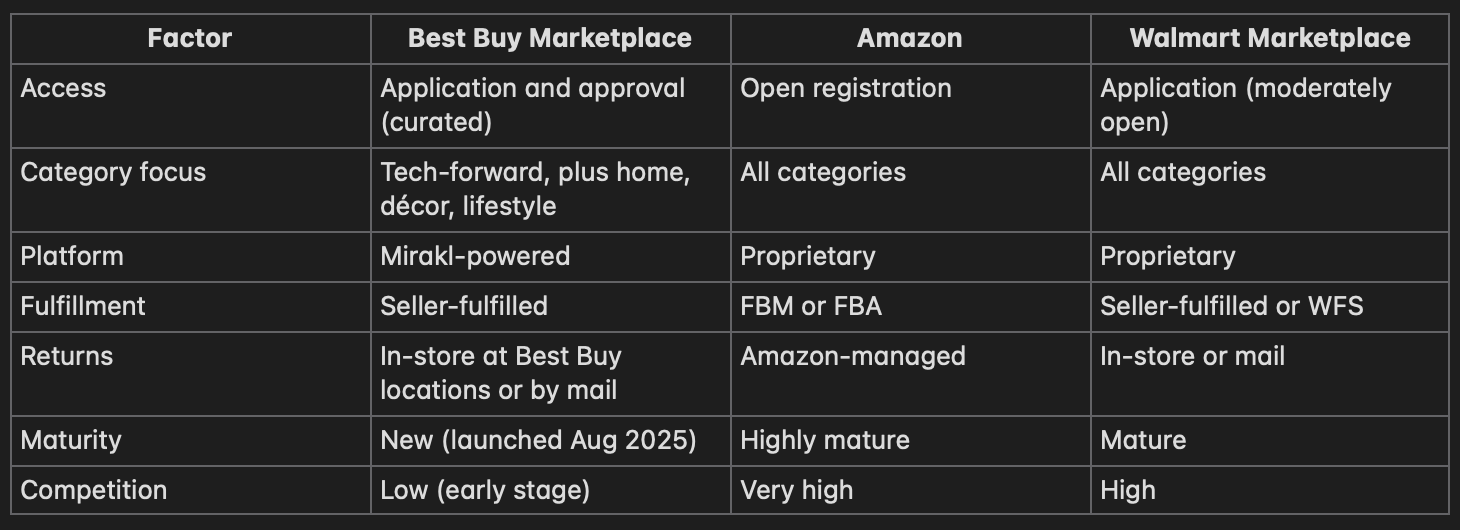
The takeaway: Best Buy Marketplace trades Amazon's sheer reach for a curated, high-trust audience and an early-mover advantage while the platform is still filling out its categories.
Is Selling on Best Buy Marketplace Worth It?
For brands in tech, tech-adjacent, home, and lifestyle categories, Best Buy Marketplace offers a high-trust audience and an early-mover advantage on a fast-growing platform. For brands with no connection to those categories, the fit is weaker.
The case for selling on Best Buy Marketplace:
- A high-trust, brand-conscious audience. Best Buy shoppers arrive expecting a curated, quality assortment, which supports considered and higher-ticket purchases.
- Early-mover advantage. Because the marketplace relaunched in August 2025, category pages are still less saturated than on mature marketplaces, so early sellers can build reviews and ranking signals ahead of later arrivals.
- In-store returns and Blue Shirt support. Customers can return marketplace purchases at Best Buy stores, and store associates can help build online carts, an omnichannel advantage pure-play marketplaces lack.
- Lower return rates. Best Buy has reported that marketplace return rates run lower than its own first-party returns, a meaningful margin signal for sellers.
The trade-offs:
- It is curated, not open. Best Buy selects sellers, so approval is not guaranteed.
- The best fit is tech-forward. While categories now extend well beyond electronics, brands with a tech, home, or lifestyle angle align most naturally with the audience.
- Early-stage tooling. As a new platform, its seller tools and advertising options are still maturing, though Best Buy has been expanding them.
- Self-fulfillment responsibility. You handle your own storage, shipping, and fulfillment performance.
Best Buy Marketplace Seller Requirements
Best Buy does not publish an exhaustive public checklist, but its seller platform and the Mirakl model it runs on point to a clear set of requirements:
- A US-based business with valid tax and banking information for payouts.
- Products that fit Best Buy's assortment, spanning tech and the newer categories like home, décor, furniture, and lifestyle.
- Complete, structured product data that meets Best Buy's catalog and attribution standards on Mirakl.
- Reliable self-fulfillment capability, since sellers store inventory and ship their own orders.
- A track record of quality and service, since Best Buy curates sellers and monitors performance and ratings to protect its brand.
- The ability to meet marketplace performance standards, including shipping speed, order accuracy, and customer service responsiveness.
How to Sell on Best Buy Marketplace: The Application Process
Becoming a Best Buy Marketplace seller is an approval-based process that starts with an application. According to Best Buy and Mirakl's launch announcement, sellers and brands apply to join the platform at BestBuy.com/Marketplace. The general flow works like this:
- Apply. Submit your seller application with your business, tax, and product information.
- Get approved and onboard. Once accepted, you set up your seller account and connect your catalog through the Mirakl portal, including shipping and returns configuration.
- Upload products and go live. Populate the required product attributes, correct any validation errors flagged by Mirakl, and once approved your listings go live on BestBuy.com and the app. You then fulfill orders yourself.
Because the platform is curated, having clean product data and a catalog that fits Best Buy's categories ready before you apply improves both your approval odds and your speed to launch. A practical advantage of the Mirakl foundation: if you already sell on another Mirakl-powered marketplace such as Lowe's, Macy's, or Nordstrom, much of your account and catalog infrastructure can carry over.
How Best Buy Marketplace Works With Mirakl
Best Buy Marketplace runs on Mirakl, the same platform that powers marketplaces for retailers like Lowe's, Macy's, Nordstrom, and Ulta. In practice, you manage your catalog, orders, inventory, and performance data through the Mirakl portal connected to BestBuy.com.
Setup centers on your product feed. You map your catalog to Best Buy's categories and required attributes, upload it through Mirakl, and correct any validation errors the system flags before products can go live. You can integrate through a direct Mirakl connection, an approved integration or feed-management provider, or the portal directly. Whichever route you choose, a real-time inventory sync is essential to prevent overselling once volume picks up.
Listing and Product Content Optimization on Best Buy Marketplace
Best Buy shoppers research before they buy, especially in tech, so complete, accurate, spec-rich product data is the foundation of visibility and conversion on the marketplace. Because your products appear next to Best Buy's own curated assortment, content quality is what makes your listing competitive on the same page.
Optimize your listings around these priorities:
- Complete product attribution. Populate every required attribute field accurately, since incomplete data can block products from going live and reduces search visibility.
- Detailed specifications. Best Buy's tech-savvy shoppers filter and compare on specs, compatibility, and features, so precision here directly drives conversion and reduces returns.
- Clear, descriptive titles. Lead with the details shoppers search, such as brand, model, key feature, and variant, rather than keyword-stuffed copy.
- Strong imagery and rich media. Use high-quality images and, where relevant, video or comparison content, which is especially important for higher-consideration and higher-ticket products.
Fulfillment, Returns, and Pricing on Best Buy Marketplace
Best Buy Marketplace is a seller-fulfilled model. You store inventory and ship orders yourself, and your fulfillment performance, including shipping speed and order accuracy, directly affects your visibility and standing on the platform. Returns come with a built-in advantage: customers can return marketplace purchases at any Best Buy store in addition to shipping them back, and Best Buy has reported that over 80% of marketplace returns happen in stores.
On pricing, you set your own prices and control your margin, so build shipping, returns, and the Best Buy commission into your pricing from the start. Because Best Buy's audience skews toward considered, higher-ticket purchases, competing on value and content quality tends to matter more than competing on the lowest price alone.
For brands selling larger tech, furniture, or home items, fulfillment is where margins are won or lost. Oversized shipping, damage rates, and return logistics for big-and-bulky products are far more complex than small-parcel fulfillment, and the ability to sustain fast, reliable delivery during demand spikes is what protects both your ranking and your reputation.
Why Returns Behave Differently and What it Demands
Best Buy has reported that marketplace return rates run lower than its own first-party business, which is unusual and worth understanding, because it is partly a function of a shopper who researches before buying and partly a function of the in-store return path. But a lower return rate only helps your margin if the returns you do get are handled cleanly and the orders you ship arrive fast and intact.
That is harder than it sounds in the larger, heavier categories Best Buy has opened up, where a single mishandled freight delivery can erase the margin advantage the platform's return profile gives you. Reverse logistics at scale is its own discipline: Spreetail, for instance, processed hundreds of thousands of returned items through its reverse-logistics operation in 2025 across 2.74 million square feet of warehouse space, the kind of infrastructure that turns returns from a cost center into a controlled process. Whether you build that capability in-house or lean on a specialized partner, treat returns and oversized fulfillment as a strategy decision before your first order, not a cleanup task after it.
What Does It Cost to Sell on Best Buy Marketplace?
Selling on Best Buy Marketplace involves a commission on each sale plus, on the Mirakl platform, a seller subscription component. Based on the commission range Mirakl publishes for its retail marketplaces, category commissions typically fall in the 8 to 15% range depending on product category. Beyond commission, you absorb your own fulfillment and shipping costs, since the model is seller-fulfilled.
When modeling your Best Buy economics, combine the category commission, any platform subscription cost, your fulfillment and shipping costs, and expected return rates to understand your true all-in cost before setting prices.
Common Best Buy Marketplace Mistakes (and How to Avoid Them)
Most Best Buy Marketplace problems trace to a handful of avoidable mistakes. Here are the ones to watch for.
- Thin product data: Products blocked at validation or buried in search.
- Fix: Complete every required attribute and spec before uploading.
- Treating it like Amazon: Over-indexing on ads and price instead of content and trust.
- Fix: Prioritize spec-rich listings and reliable service; the audience rewards it.
- Weak fulfillment performance: Late shipments drop visibility and standing.
- Fix: Treat fast, accurate dispatch as a non-negotiable standard.
- Underpricing without modeling costs: Margin erodes after commission, subscription, and freight.
- Fix: Build all costs into your price before listing.
- No big-and-bulky plan: Oversized orders cannot be fulfilled profitably.
- Fix: Line up freight and oversized capability before listing large items.
- Ignoring reviews and Q&A: Lower conversion on a trust-driven platform.
- Fix: Build review generation and fast Q&A response into your workflow.
How to Grow on Best Buy Marketplace
Growing on Best Buy Marketplace rewards being early and operationally consistent. Because the platform is still young, sellers who establish strong listings, reviews, and fulfillment records now can build a position that later arrivals will struggle to displace.
Start with your strongest, spec-complete SKUs in categories closest to Best Buy's assortment, then expand systematically once those listings perform. Maintain complete product data and reliable fulfillment as you scale, explore Best Buy's growing marketplace advertising options to amplify proven listings, and keep pricing and brand presentation consistent across every channel you sell on. Best Buy works best as one deliberate piece of a broader multi-channel plan rather than a standalone bet, and treating it as an ecommerce growth accelerator, a channel that compounds alongside your others rather than competing with them, is what separates sellers who plateau from those who keep climbing. For a wider view of how that compounding works, see how Spreetail approaches multi-channel marketplace expansion and marketplace growth across platforms.
Best Buy Marketplace is one of the clearest early-mover opportunities in retail right now: young, curated, and expanding fast beyond electronics. The brands that get in early, list with complete and accurate data, and run reliable fulfillment can build a position that compounds as the platform matures. Get those fundamentals right, and Best Buy becomes a durable channel rather than a one-time experiment.
Frequently Asked Questions
Does Best Buy have third-party sellers?
Yes. Best Buy relaunched its US third-party marketplace in August 2025 on the Mirakl platform, after closing an earlier attempt in 2016. Within about three months it had signed on more than 1,000 sellers and greatly expanded its online assortment.
How do I sell on Best Buy Marketplace?
You apply to become a seller at BestBuy.com/Marketplace. Once approved, you set up your account and connect your catalog through the Mirakl portal, upload your products with required attributes, and go live after review. You then fulfill orders yourself.
Is Best Buy Marketplace only for electronics?
No. While Best Buy is known for tech, the marketplace deliberately expanded into categories like home, furniture, seasonal décor, automotive tech, small appliances, toys, musical instruments, and licensed sports merchandise.
How much does it cost to sell on Best Buy Marketplace?
Best Buy charges a commission on each sale, typically in the 8 to 15 percent range depending on category based on Mirakl's published marketplace ranges, plus a Mirakl seller subscription component. You also cover your own fulfillment and shipping costs.
Can customers return Best Buy Marketplace products in store?
Yes. Customers can return marketplace purchases at Best Buy stores in addition to shipping them back to the seller. Best Buy has reported that most marketplace returns happen in stores.
Is selling on Best Buy Marketplace worth it?
For tech, home, and lifestyle brands, it offers a high-trust audience, in-store returns, lower-than-first-party return rates, and an early-mover advantage on a fast-growing platform. For brands with no connection to those categories, the fit is weaker.