How to Sell on Home Depot: The Complete Guide to Every Selling Route

If you have searched "how to sell on Home Depot," you have probably noticed the answers contradict each other. Some say it is a simple online marketplace like Amazon. Others describe an invitation-only supplier relationship. Both are partly right, because "selling on Home Depot" is not one program. It has three distinct routes, each with its own requirements, economics, and approval process.
This guide separates them clearly: the online marketplace and drop-ship program, becoming a first-party Home Depot supplier, and the newer creator and affiliate route. Whether you are a brand looking to list products on HomeDepot.com, a manufacturer hoping to get on store shelves, or a seller weighing whether Home Depot is worth the operational lift, this guide covers what each path requires and how to choose.
What Does "Selling on Home Depot" Actually Mean? Three Different Routes
Selling on Home Depot can mean one of three things: listing your products on HomeDepot.com as a third-party seller who ships directly to customers, supplying products wholesale for Home Depot to sell as its own inventory, or partnering as a content creator through Home Depot's affiliate program. These are separate programs with different applications, and confusing them is the most common mistake sellers make.
Home Depot is the largest home improvement retailer in the world, operating more than 2,000 stores across North America. That scale is why the selling opportunity is attractive, and why the pathways onto its platform are more structured than a typical open marketplace.
The Online Marketplace / Drop-Ship Program
This is the closest equivalent to selling on Amazon or Walmart Marketplace. Approved third-party sellers list products on HomeDepot.com, and when a customer orders, the seller (or their fulfillment partner) ships the product directly to the customer's home or to a Home Depot store for pickup. Home Depot does not take ownership of the inventory. This route is often referred to as Home Depot's drop-ship program, and it is the primary path for brands that want their catalog visible on HomeDepot.com without going through the wholesale buying process.
Becoming a Home Depot Supplier (First-Party / In-Store)
This is the traditional retail path: Home Depot buys your product wholesale and sells it as its own inventory, potentially both online and in physical stores. This route runs through Home Depot's merchandising organization rather than a self-serve portal. Home Depot actively recruits suppliers. In November 2025, it announced The Orange Exchange, an event hosting prospective merchandise suppliers onsite for targeted pitch sessions and product capability demonstrations, scheduled for February 19, 2026. Selected suppliers are assessed on criteria including market readiness, domestic production capacity, and fulfillment capabilities. U.S.-based small businesses can submit product proposals through Home Depot's official suppliers portal.
Home Depot Marketplace vs. Amazon and Walmart
For brands already selling on other marketplaces, the fastest way to understand Home Depot is by contrast. The table below compares the third-party online marketplace route specifically (not the wholesale supplier route) against the two largest open marketplaces.
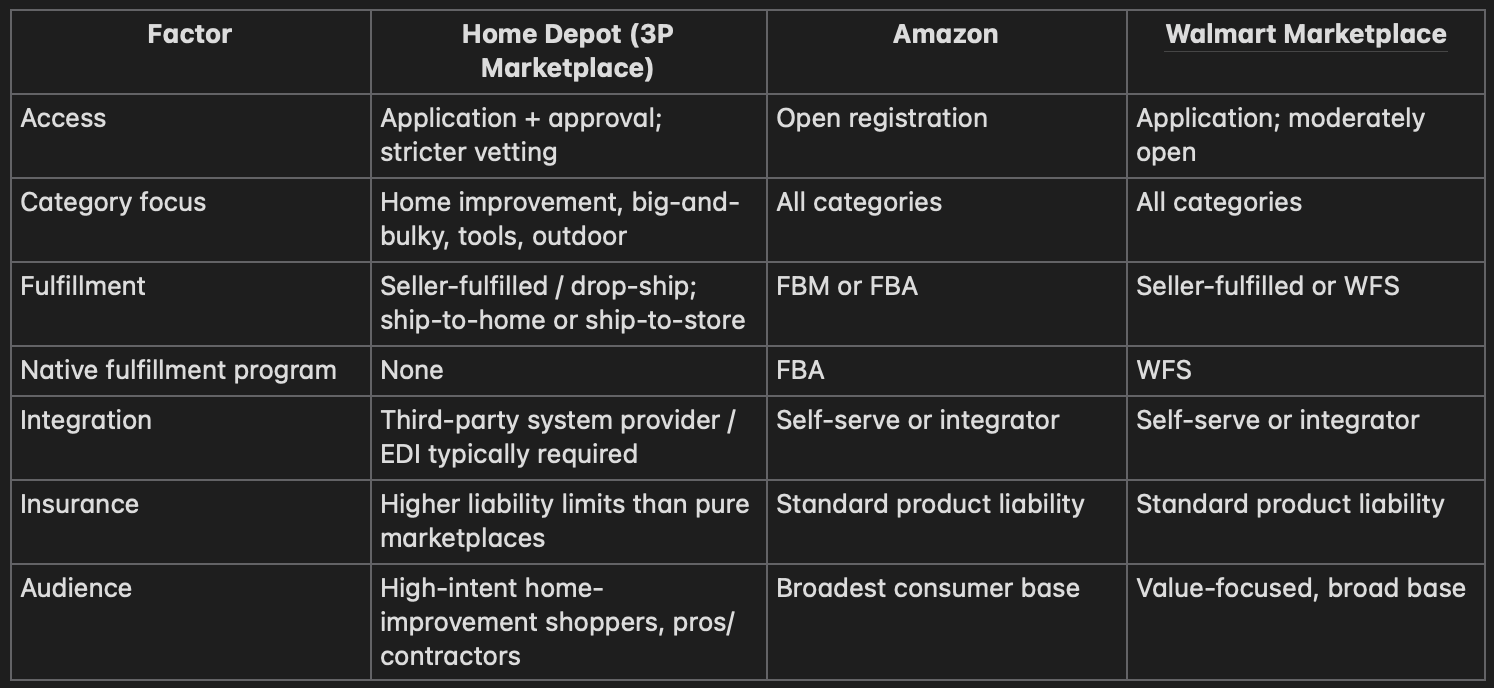
The takeaway: Home Depot's marketplace is narrower and more operationally demanding to join, but the audience is highly qualified for home, hardware, outdoor, and big-and-bulky products, with less direct seller saturation than on Amazon.
Is Selling on Home Depot Worth It? Benefits and Trade-offs
For the right brand, particularly in home improvement, tools, outdoor, and big-and-bulky categories, Home Depot offers access to a large, high-intent audience with less marketplace saturation than Amazon. For brands outside those categories, or those not ready for its operational requirements, it can be a poor fit.
The case for selling on Home Depot:
- A highly qualified audience. Home Depot shoppers arrive with home-improvement intent, which suits considered and higher-ticket purchases better than impulse-driven channels.
- Strong category fit for big-and-bulky. Home Depot's logistics and customer base are built around large, heavy products that are difficult and expensive to sell elsewhere, giving brands in those categories a structural advantage.
- Less seller saturation. The vetting barrier that makes Home Depot harder to join also means fewer competing sellers once you are in.
- Ship-to-store option. The ability to route orders to stores for pickup is a fulfillment and convenience lever most marketplaces do not offer.
The trade-offs:
- Higher operational bar. Home Depot typically requires EDI-capable integration through a system service provider, plus routing-guide and labeling compliance that carries chargeback risk if missed.
- Stricter insurance requirements. As a brick-and-mortar retailer, Home Depot generally requires higher commercial general liability limits than pure marketplaces. Wholesale and retailer certificates of insurance, including Target, Home Depot, Lowe's, and Walmart, typically require higher limits, specific endorsement forms, waiver of subrogation, and primary/non-contributory wording.
- Less mature 3P infrastructure. Compared with Amazon Seller Central or Walmart's seller tools, Home Depot's third-party seller tooling and reporting are less developed.
- Approval is not guaranteed or fast. Both the marketplace and supplier routes involve vetting and can take time.
Home Depot Seller Requirements: Do You Qualify?
Home Depot does not publish a single exhaustive checklist, but the following requirements are well-documented and consistent across the online marketplace and supplier routes:
- A registered U.S. business entity (or, for some supplier programs, an approved international entity)
- A Global Location Number (GLN), a standardized business identifier used for electronic data exchange.
- Commercial general liability insurance (Certificate of Insurance) meeting Home Depot's specified limits
- A verifiable history of selling products online, typically with review history and ratings
- EDI (Electronic Data Interchange) capability, usually via an approved third-party system service provider
- U.S.-based fulfillment (no overseas drop-shipping)
- GS1-valid UPC/barcodes on all products
- Compliance with Home Depot's routing guide, labeling, and packaging standards
The insurance requirement deserves special attention because it catches sellers off guard.
Home Depot Insurance and COI Requirements
A COI (Certificate of Insurance) is proof that your business carries commercial general liability coverage. Home Depot requires it, and its limits are typically higher than those required by open marketplaces. Home Depot Product Authority, LLC requires suppliers to maintain commercial general liability insurance with the limits indicated in the Supplier Buying Agreement, processed through Exigis, and complying with specific certificate holder language. In practice, marketplace-only platforms like Amazon and eBay tend to accept lower minimum limits, while brick-and-mortar retailers such as Home Depot face premises-liability exposure and require higher aggregate limits by category.
Budget for this early. A seller who cannot meet the insurance limits cannot complete onboarding, regardless of product quality.
How Much Does It Cost to Sell on Home Depot?
Selling on Home Depot involves three cost layers: a referral or commission fee on each sale, integration costs through a required system service provider (typically a setup fee plus a per-order charge), and insurance. Home Depot does not publish a full public fee schedule, so exact rates should be confirmed during onboarding.
Unlike Amazon or Walmart, Home Depot's third-party program does not offer a native fulfillment service, so there are no FBA-style storage or pick-and-pack fees, but you absorb all fulfillment and shipping costs yourself. When budgeting, model the referral fee, the integration provider's setup and per-order fees, insurance premiums, and your own fulfillment costs together to get a true all-in figure.
How to Apply and Get Approved
The application path depends on which route you are pursuing.
For the online marketplace / drop-ship route: You apply to become a third-party seller, providing business information, tax identification, your GLN, proof of insurance, and evidence of online sales history. Home Depot reviews the application and, if approved, moves you into integration and onboarding. A demonstrated track record on other channels strengthens your case, while a catalog with substantial review history signals operational maturity.
For the supplier / first-party route: This runs through Home Depot's merchandising organization, not a self-serve seller portal. U.S.-based businesses can submit product proposals through Home Depot's official suppliers portal, and Home Depot also recruits through events like The Orange Exchange. Suppliers are evaluated on market readiness, domestic production capacity, fulfillment capabilities, and product innovation.
Either way, approval favors brands that can prove they can operate reliably at Home Depot's standards before they are let in. Build verifiable sales history, clean product data, and fulfillment readiness first.
How to Integrate With Home Depot: Systems, EDI, and Feed Management
Integration is where Home Depot differs most from open marketplaces, and where most guides go quiet. Home Depot's order and inventory processes generally require EDI (Electronic Data Interchange), a standardized format for exchanging purchase orders, shipment confirmations, and inventory updates that most in-house catalog systems cannot produce natively.
In practice, this means most sellers connect through an approved third-party system service provider that handles the EDI exchange, order routing, and inventory syncing. Expect a setup process and ongoing per-order costs. Before you begin, get three things in order: clean, standardized product data; GS1-valid barcodes; and a decision on whether you will use an integration provider or build EDI capability in-house (most sellers use a provider).
Handled well, integration is a one-time lift that then runs quietly. Handled poorly, with mismatched data, broken feeds, or non-compliant shipment files, it produces chargebacks and suppressed listings.
Listing and Product Content Optimization on Home Depot
Home Depot shoppers search by specification. Someone buying a fixture, fastener, or fence panel is filtering by dimensions, material, finish, and compatibility, so complete and accurate structured product data matters more here than keyword-loaded copy.
- Titles that lead with brand, product type, and the key differentiating spec (size, material, finish), matching how home-improvement shoppers describe products.
- Images that clearly show the product on a clean background, along with in-context and scale shots, are critical for big-and-bulky items where customers need to gauge size.
- Specifications and attributes completed in full. Incomplete spec data is the single most common reason home-improvement listings underperform in filtered search.
- Rich content including demonstration or installation videos and detailed descriptions, is important for any product where fit, assembly, or use is not obvious.
Accuracy is not just a conversion lever here; it reduces returns, which protects your seller standing.
Inventory, Fulfillment, and Shipping Requirements
Home Depot's third-party model is seller-fulfilled. You are responsible for storage, pick-and-pack, and shipping, with two delivery paths: direct to the customer's home or to a Home Depot store for pickup. There is no native fulfillment program equivalent to FBA or WFS.
The requirements that most affect your seller standing:
- Routing-guide and labeling compliance. Home Depot enforces specific barcode formats, packaging standards, and carrier requirements. Violations trigger chargebacks and damage seller ratings.
- Timely dispatch and valid tracking. Late shipments and missing tracking degrade performance metrics that influence visibility.
- U.S.-based fulfillment only. Overseas drop-shipping is not permitted.
- Big-and-bulky readiness. Home Depot's catalog skews toward large, heavy items. If you sell in these categories, freight, LTL, and oversize handling capability are prerequisites, not afterthoughts.
Fulfillment reliability is not a back-office concern here. It directly feeds the performance metrics that determine whether your listings stay visible.
Pricing and Sales Optimization
Once you are live, sustained performance comes from pricing discipline, review velocity, and understanding Home Depot's buyer.Its audience skews toward pros, contractors, and serious DIY customers, buyers who value durability, specification accuracy, and availability over the lowest possible price.
Focus your optimization on: competitive but margin-protecting pricing (factor in your fulfillment and integration costs before setting prices); organic review generation through post-purchase follow-up, since reviews carry heavy weight for considered home-improvement purchases; complete specification data to win filtered search; and awareness of Home Depot has pronounced seasonal cycles, with spring and summer focused on outdoor, lawn, and garden products, and fall and winter focused on indoor projects and seasonal categories.
Common Home Depot Selling Mistakes and How to Avoid Them
Most Home Depot selling problems trace back to a handful of avoidable mistakes. Here are the six we see most often, with the fix for each.
- Choosing the wrong route: Brand applies to the marketplace when it wanted wholesale placement (or vice versa)
- Decide upfront: list-and-ship-yourself (marketplace) vs. sell-wholesale-to-HD (supplier)
- Underestimating insurance: Onboarding stalls because COI limits aren't met
- Confirm required limits and secure a compliant COI before applying
- Ignoring routing-guide compliance: Labeling/packaging violations trigger chargebacks
- Follow the routing guide exactly; audit shipments before they go out
- Thin specification data: Listings lose in filtered/spec-driven search
- Complete every attribute field; treat spec data as a launch blocker
- Treating it like Amazon: Over-indexing on keywords and ads instead of data accuracy and reliability
- Prioritize structured data, fulfillment reliability, and reviews
- No big-and-bulky plan: Oversize orders can't be fulfilled profitably
- Line up freight/LTL/oversize capability before listing large items
How to Scale on Home Depot
Scaling on Home Depot rewards operational consistency more than aggressive expansion. The brands that grow are the ones that prove reliability on a focused catalog, then expand deliberately.
Start with your strongest, most spec-complete SKUs, ideally in categories where Home Depot's audience is strongest, such as tools, hardware, outdoor, and big-and-bulky home products. For brands in these categories specifically, winning the tools and home improvement category across marketplaces takes the same content, review, and fulfillment discipline that Home Depot rewards, applied consistently everywhere you sell.
Once those listings show strong content, reviews, and clean fulfillment metrics, expand systematically. Maintain routing-guide compliance and data accuracy as you add volume, because performance problems compound at scale. And keep pricing, branding, and fulfillment consistent across every channel you sell on. Multi-channel reliability is what earns expanded placement over time.
Frequently Asked Questions
Can anyone sell on Home Depot?No. Unlike fully open marketplaces, Home Depot vets sellers. You generally need a registered U.S. business, a Global Location Number, commercial liability insurance meeting Home Depot's limits, EDI-capable integration, U.S.-based fulfillment, and a verifiable online sales history. Approval is required before you can list.
Does Home Depot have a marketplace like Amazon?Partly. Home Depot has a third-party online program where approved sellers list on HomeDepot.com and ship directly to customers, similar in concept to Amazon's FBM model. But it is more vetted, has no native fulfillment program like FBA, and typically requires EDI integration through a system service provider.
How much does it cost to sell on Home Depot?
Costs include a referral/commission fee per sale, integration provider fees (setup plus per-order), insurance, and your own fulfillment costs. Home Depot does not publish a full public fee schedule, so confirm exact rates during onboarding. There are no FBA-style storage fees because fulfillment is seller-managed.
How do I become a Home Depot supplier?
The supplier (wholesale) route runs through Home Depot's merchandising team, not a seller portal. U.S.-based businesses can submit product proposals through Home Depot's official suppliers portal, and Home Depot recruits suppliers through events like The Orange Exchange, evaluating market readiness, domestic production capacity, fulfillment capability, and innovation.
Do I need insurance to sell on Home Depot?
Yes. Home Depot requires a Certificate of Insurance showing commercial general liability coverage that meets its specified limits, processed through its insurance verification system. Its limits are generally higher than those required by marketplace-only platforms, so confirm requirements before applying.
Is selling on Home Depot worth it?
For brands in home improvement, tools, outdoor, and big-and-bulky categories, Home Depot offers a high-intent audience with less seller saturation than Amazon, which can make it a worthwhile channel. For brands outside those categories or not ready for its integration and insurance requirements, the operational lift may outweigh the benefit.