From Chaos to Control: The Key to Maximizing Profitable Ecommerce Growth

With ecommerce marketplace sales continually accounting for a larger portion of brand revenue, brand protection has become an essential element for maximizing profitable ecommerce growth. Regrettably, many brands remain unaware of the significance of brand protection, leading to challenges in optimizing sales, preserving brand value, and enhancing the buyer's experience.
This resource offers valuable insights into the critical importance of brand protection in fostering a thriving and expanding business. Whether your brand has previously overlooked the need for asserting control over online sales, has authorized multiple sellers on marketplaces, or is struggling with unauthorized resellers, we will explore how taking control can significantly enhance your online business.
What Is Brand Protection & Why Does It Matter?
Brand protection involves brands exerting authority over their distribution channels, marketplace selling strategy, and unauthorized sellers of their products. This ensures optimized sales and preserves brand value. The increasing prominence of open online marketplaces, such as Amazon and Walmart, has made brand protection an essential strategy. These marketplaces allow anyone to list a brand's products, which can disrupt both marketplace and omnichannel go-to-market strategies. Counterfeiters and other malicious actors continually engage in illicit activities on these platforms, posing additional risks to both brands and consumers.
Lack of control in today's interconnected omnichannel world leads to several consequential outcomes:
- Lost sales due to unauthorized resellers
- Disrupted advertised pricing on highly visible marketplace platforms
- The inability to effectively advertise on Amazon
- Poor inventory management resulting in out-of-stock items and delays in order fulfillment
- Inconsistent branding diluting a company's image and decreasing customer trust
- Increased negative reviews due to inferior quality products and sellers
- Inability to run an effective MAP program across the omnichannel landscape
- Harmful channel conflict with brick-and-mortar distributors and retailers causing business harm
Consequences of Insufficient Brand Protection
Insufficient brand protection prevents brands from realizing their maximum growth and profitability potential on Amazon and other marketplaces including traditional brick-and-mortar channels. In the following section, we will dive deeper into these critical issues.
Marketplace Business
When brands lack control over their marketplace business, issues emerge that negatively impact their ability to optimize profitable growth in the channel. These include:
- Multiple resellers: Amazon and other marketplaces offer a selling platform accessible to anyone capable of sourcing your products through various means such as arbitrage, diversion, liquidation, theft, and other undesirable methods. It is important to understand that as the number of resellers increases on Amazon and other marketplaces, the performance of your business is likely to decline. The presence of multiple resellers discourages the implementation of strategies essential for driving sales. Succeeding on marketplaces necessitates strict limitations on the number of resellers authorized to sell your products, ideally down to a single exclusive seller dedicated to fostering brand growth in the channel.
- Eroded advertised prices: When multiple sellers offer the same product, relying solely on pricing as a differentiator, a race to the bottom ensues, resulting in the erosion of hard-earned brand value. This leads to compromised advertised pricing and poses challenges in implementing successful Minimum Advertised Price (MAP) or other pricing programs across the entirety of your business.
- Impeded advertising capabilities: Due to frequent Buy Box disruptions, advertising dollars are spent inefficiently with limited effectiveness and high campaign interruptions. Certain ads will not run when a brand does not own the Buy Box. For others, the brand will also experience ROI erosion from both onsite and offsite ads directing to inconsistent product detail pages from an unauthorized reseller, further diminishing return on marketing spend and negatively impacting overall growth tactics.
- Inventory management challenges: When multiple sellers compete for the Buy Box, the demand signals for each seller become highly volatile. This creates an unpredictable environment where sellers base their ordering decisions on historical sales velocities, which may not accurately reflect the current demand. In such scenarios, increased out-of-stock rates lead to missed sales and dissatisfied customers, while overstocked situations become more likely as sellers who expected higher Buy Box wins are left with excess inventory, straining the brand-seller relationship and increasing the risk of brand erosion.
- Increased negative reviews: In the absence of proper quality controls, reliable delivery commitments, and effective customer service handling, customers may encounter issues that reflect poorly on both the brand and the marketplace channel, resulting in increased negative product reviews that will negatively impact category ranking and sales.
Negative Impacts on Other Sales Channels
When brands lack control on Amazon and other marketplaces, the negative repercussions extend beyond their marketplace business and infiltrate their other sales channels. In today's interconnected omnichannel landscape, a lack of control results in the following:
- Channel conflict: The absence of brand protection on online marketplaces swiftly gives rise to channel conflict. Retailers and distributors raise concerns about advertised pricing discrepancies on marketplaces, diminishing their ability to remain invested in the brand. Forced to compete with uninvested marketplace sellers, traditional channels suffer, leading to dissatisfaction and disrupted partnerships.
- Diminished brick-and-mortar sales: Traditional brick-and-mortar channels typically serve as the foundation of most brands' business. However, when channel conflict arises, brands often experience a decline in their traditional sales. Customers increasingly engage in "showrooming," opting to purchase cheaper products on marketplace platforms instead of visiting physical stores and dealerships where invested channel customers have made investments in knowledgeable sales teams, displays and other business drivers.
- Strained customer relationships: As the dynamics unfold, brands inevitably encounter strained relationships with their offline channel customers. These outlets may seek to impose chargebacks and demand margin guarantees, putting the brand at risk of reduced shelf space or even the possibility of being dropped from their offerings altogether.
- Diminishing profitability across channels: Brands become trapped in a detrimental cycle of online erosion that spills over into their brick-and-mortar channels, intensifying the online erosion even further. This leads to a decline in profitability across all channels, negatively impacting the brand's overall financial performance.
The Power of Brand Protection: Unlocking Profitable Ecommerce Acceleration
Let's explore the possibilities that arise when a brand exercises control over its online sales.
The brand can establish a valuable partnership with a dedicated ecommerce acceleration expert, empowering significant sales growth on marketplaces while safeguarding brand integrity. With this level of control, the brand can confidently invest in advertising and employ other marketplace sales growth tactics, knowing that it will not drive traffic to unauthorized sellers and experience subpar returns on marketing investment.
By stabilizing its presence on marketplaces, the brand can prevent disruptions to its brick-and-mortar channels, sparing customers from the negative impact of uncommitted, low-quality resellers that erode brand value. This approach ensures profitability and fosters strong customer relationships across core business channels. We delve deeper into the benefits of brand protection below:
- Enables increased marketing spend with optimal effectiveness and low interruption. Without it, a brand is unable to spend at optimal levels, rendering some tactics unavailable and ineffective.
- With keyword-based performance enhancements, minimal content changes, and consistent product descriptions, improved organic win rates are achieved.
- Efficient allocation of advertising dollars and minimal disruption result from brand protection, ensuring optimal effectiveness and low interruption.
- Avoid ROI erosion caused by offsite ads leading to competing sellers or unauthorized resellers' product detail pages.
- Consistently delivering optimized content, improving accuracy and attribution, building conversion confidence, and ensuring customer journey security.
- Improved advertised price compliance leads to better margins, reduced channel conflict, and avoidance of chargebacks or Prime renegotiations, maximizing pricing and profitability.
- Brand consistency facilitates successful expansion into new channels, allowing effective brand representation by 3P partners like Spreetail.
- By implementing brand protection, businesses can drive more traffic, increase profitable sales growth, and establish a strong category presence on marketplaces.
How We Create a Growth Cycle
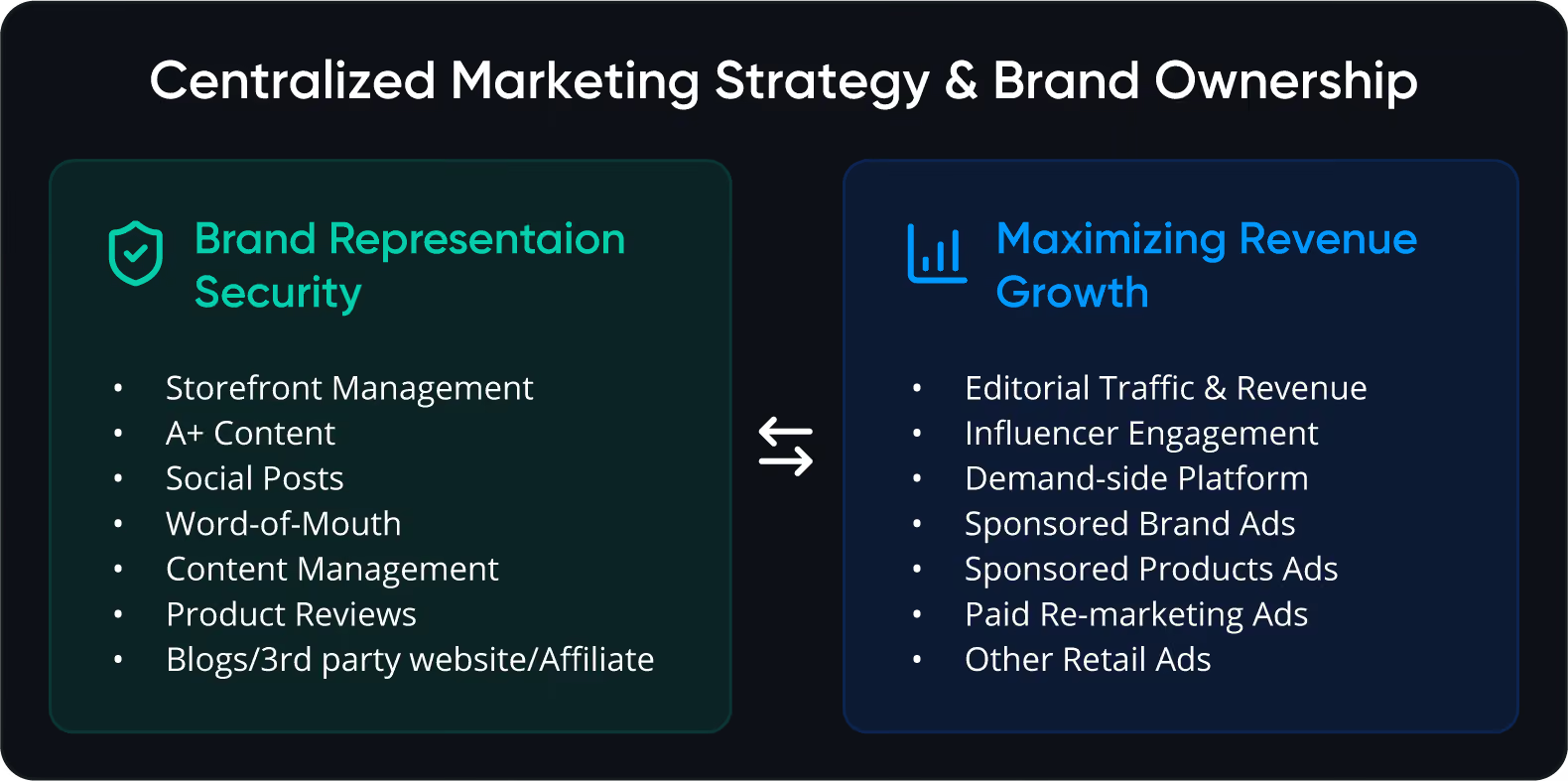
3P Partnership Effectiveness: Improved ROI & Spend Quality
Brand protection serves as a catalyst, enabling trusted 3P sellers to flourish and expand their market share. To extract the utmost value for you and your customers, it is imperative to establish a solid foundation. Partnering with a reputable 3P partner offers the following advantages:
Common Brand Protection Misconceptions
"It's good to have multiple marketplace sellers selling my products on Amazon and other platforms."
The more sellers you have, the less you will be able to optimize marketplace sales and profitability. Winning brands have one, or very few, dedicated sellers offering their products that are highly invested in doing the things needed to drive growth.
"I don't care about uncontrolled marketplaces because I already made the sale."
Brand leaders are often unaware of the omnichannel harms that will occur as a result of uncontrolled marketplaces, including channel conflict, and diminished business across all sales channels.
"I don't want to disrupt my customer relationships."
You won't! One of the best things brands can do to protect their dedicated offline customers is assert control over marketplace sales to prevent online disruption from harming their traditional business channels.
"My lawyers say it's not possible."
There are highly specialized legal experts that provide proven, holistic solutions to online sales control challenges.
"I already have a MAP policy, Brand Registry, brand protection vendor and/or reseller policies."
None of these tools can successfully deliver online sales control as they are not applicable to unauthorized sellers. Unauthorized sellers require a specific legal approach — see the point above.
How Does My Brand Get More Protection?
Brand protection requires that brands make an enterprise-level commitment, aligning sales, ecommerce, and legal teams to this common goal: having 95% of marketplace sales made by their authorized seller. This is what unlocks acceleration.
Next, brands must understand that they cannot take a fragmented approach to brand protection — that is, they should not try to leverage various internal and external resources to achieve this goal. Many brands make the mistake of relying on a patchwork of existing brand protection vendors, MAP monitoring vendors, time-constrained internal resources, traditional law firms or ecommerce agencies. These approaches are rarely successful because they invariably fail to bring forward all the capabilities needed to ensure that the brand's authorized seller consistently wins most sales.
Instead, brands should partner with a holistic brand protection solution provider that is able to provide the requisite legal foundation, tech stack, investigative capabilities, brand protection services, reseller compliance capabilities and enforcement services needed to truly achieve brand protection in today's omnichannel environment. This is a highly specialized area.
Spreetail believes strongly in the power of brand protection and the growth it can help deliver for brands when they have the necessary strategy in place.
Brand protection journey framework and timeline
- Strategic alignment: Aligning sales, ecommerce, and legal leadership to the control goal and associated KPI (95% of sales owned by the authorized seller) and the brand's custom blueprint for achieving this goal. Brands should aim to complete this step within 30 days.
- Monitoring & data: Brands then need to implement the right technology stack that informs them of all sellers of their products and the volumes and revenues being accomplished by each seller. This allows brands to understand their current landscape, the financial ROI associated with greater control, where the brand's product leaks are occurring, and enables the brand to direct its enforcement efforts against the right sellers at the right time to ensure that the authorized sales KPI can be consistently driven forward.
- Authorized and unauthorized seller legal foundations: Designing, preparing, and implementing the necessary foundation that empowers brands to have the necessary policies and procedures in place that enable appropriate channel control over authorized sellers and the legal ability to enforce against and remove unauthorized sellers. Brands should aim to have their policies prepared, approved, and implemented in 60 days.
- Reseller compliance management: Next, brands need to leverage data, tools, and specialized professionals to consistently monitor and manage their resellers to ensure compliance with the brand's policies.
- Enforcement: Brands must also be able to perform necessary enforcement work against authorized customers selling in unapproved channels, unauthorized sellers that obtain a brand's products and sell them in an unapproved and disruptive manner on online marketplaces, as well as any counterfeiters or other IP (intellectual property) violators that are impacting the brand's strategy. All enforcement initiatives need to be managed so that the brand is constantly pushing the authorized sales KPI rather than some commercially meaningless vanity metric like the number of sites monitored or takedowns made.
- KPI tracking and iteration: Finally, the brand should be regularly monitoring the sales owned by its authorized seller in its quest to reach the 95% threshold and iterate strategies as needed considering the ground realities and the constantly shifting landscape.
Brands can achieve tremendous commercial outcomes through these initiatives. Indeed, it is common for brands to implement a holistic approach and see millions of dollars of growth in their authorized sales, MAP compliance increased several folds, and better business empowered in the brand's brick-and-mortar channels.
Brand Case Studies
Haden Appliances — 71% removal rate of unauthorized sellers

Within just five months of initiating enforcement, Vorys eControl has achieved a removal rate of over 71% for unauthorized sellers across shared brands with Spreetail. For Haden USA, Vorys swiftly identified the most disruptive seller, responsible for more than 50% of the estimated unauthorized revenue. Further investigation revealed that this seller was sourcing products from a subsidiary of a national hardware co-op. Armed with this insight, Haden took immediate action to cut off the seller's supply chain, resulting in the seller becoming inactive. To date, the removed sellers represent 66% of the overall unauthorized sales during the enforcement period.
Yakima — 73.8% removal rate of unauthorized sellers

Since June 2024, Yakima's enforcement efforts have resulted in the removal of 45 out of 61 (73.8%) targeted Amazon storefronts involved in unauthorized sales of Yakima products. During this time, authorized Buy Box control increased from 78% to 89%. Among the removed sellers were the three most disruptive by revenue, collectively accounting for over $105K in unauthorized sales from the start of enforcement to their removal. Overall, sellers representing more than $156K in unauthorized revenue were eliminated, contributing to a 4% reduction in unauthorized Buy Box control.
A significant milestone included securing the permanent cessation of active Yakima product sales by the most disruptive seller, represented by sophisticated legal counsel. Additionally, this seller agreed to disclose its overseas sourcing channels, enabling Yakima to address cross-border product leakage effectively.
Sterilite — 72.4% removal rate of unauthorized sellers
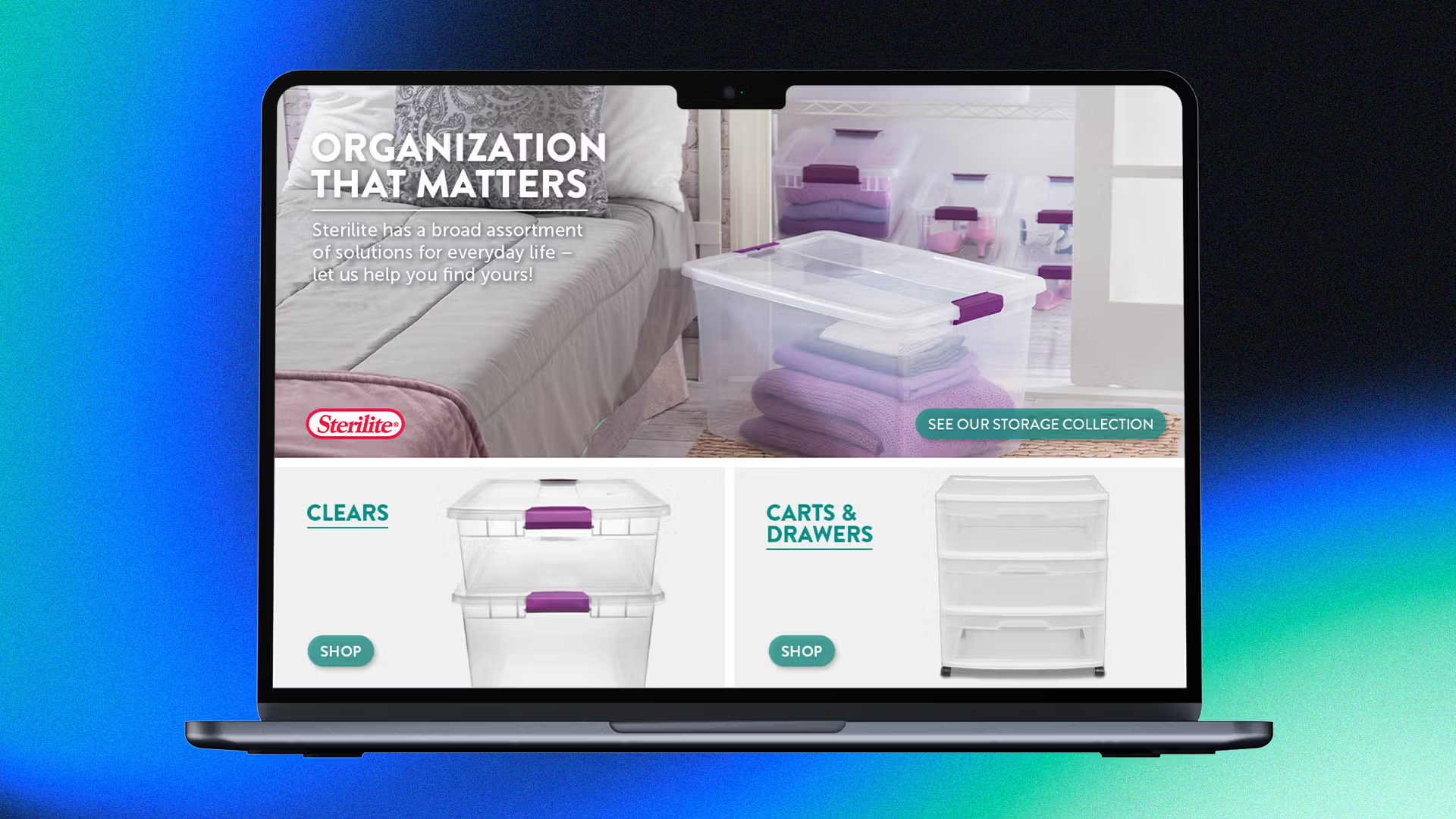
Since April 2024, enforcement efforts with Sterilite have successfully removed 84 of 116 (72.4%) Amazon storefronts engaged in unauthorized sales of Sterilite products. These actions led to a significant increase in authorized revenue capture, rising from $678K to $906K per month. Among the removed sellers were 80% of the most disruptive by revenue, collectively accounting for over $120K in unauthorized sales from the start of enforcement to their removal. Overall, Sterilite has achieved a $169K reduction in unauthorized revenue.
A key accomplishment was negotiating sell-through agreements and securing the permanent cessation of listings from the most disruptive sellers.
Next Steps: Establishing Brand Protection
The bottom line is clear: by establishing greater control over your online marketplace sales, your brand can unlock improved business outcomes. At Spreetail, we are eager to join forces with you to protect your brand in effort to accelerate your brand's marketplace sales.
Choose Spreetail as your trusted full-service ecommerce acceleration partner. We purchase your products and also expertly sell them across more than 20+ marketplaces globally including Amazon, Walmart, TikTok Shop, Target, and more. With our commitment to Prime status and fast shipping options, including 2-day or even next day delivery for 85% of the country, your customers will experience exceptional service. Additionally, our data-driven marketing and advertising strategies are tailored to your specific objectives, enabling us to propel your business towards unprecedented growth across the digital landscape.
Ready to protect your brand while you grow?
Spreetail values brand partners that commit to greater brand protection and will work in partnership with qualifying brands to facilitate critical brand protection work. Reach out to our team today to see how Spreetail can grow your revenue across marketplaces while keeping your brand protected.