MAP vs MSRP: What Every Manufacturer Needs to Know About Pricing Control

MAP and MSRP are often used interchangeably, and that confusion costs manufacturers real money. They sound similar and both involve a number a brand sets, but they do completely different jobs: one is a suggestion, the other is a line that can be enforced. A manufacturer that treats them as the same thing, or sets one without the other, leaves its pricing exposed to the discounting and channel chaos that erode a brand's value. This guide explains what each term means, how they differ, whether MAP is actually legal, and how manufacturers use both to keep pricing under control across marketplaces.
What is MSRP?
MSRP, the Manufacturer's Suggested Retail Price, is the price a manufacturer recommends retailers charge consumers. The key word is suggested. MSRP is a reference point, not a rule: it gives retailers a benchmark and gives shoppers a sense of what a product is worth, but a retailer is generally free to sell above or below it. MSRP shapes perception and anchors discounts, but on its own it does not stop a reseller from slashing the price.
What is MAP?
MAP, the Minimum Advertised Price, is the lowest price at which a manufacturer permits its authorized resellers to publicly advertise a product. Unlike MSRP, MAP is enforceable through the reseller agreement: a retailer that advertises below MAP can face consequences such as losing authorized-seller status. Crucially, MAP governs the advertised price, not the final checkout price. A retailer can still sell below MAP, through an in-cart discount or at checkout, as long as it does not publicly advertise that lower price.
That distinction is the whole point of MAP. It lets a manufacturer protect the publicly visible price that shapes brand perception and retail-partner relationships, without dictating the actual transaction price, which is where the legal line sits.
MAP vs MSRP: the Key Differences
The simplest way to hold the two apart is by what they control and whether they can be enforced.
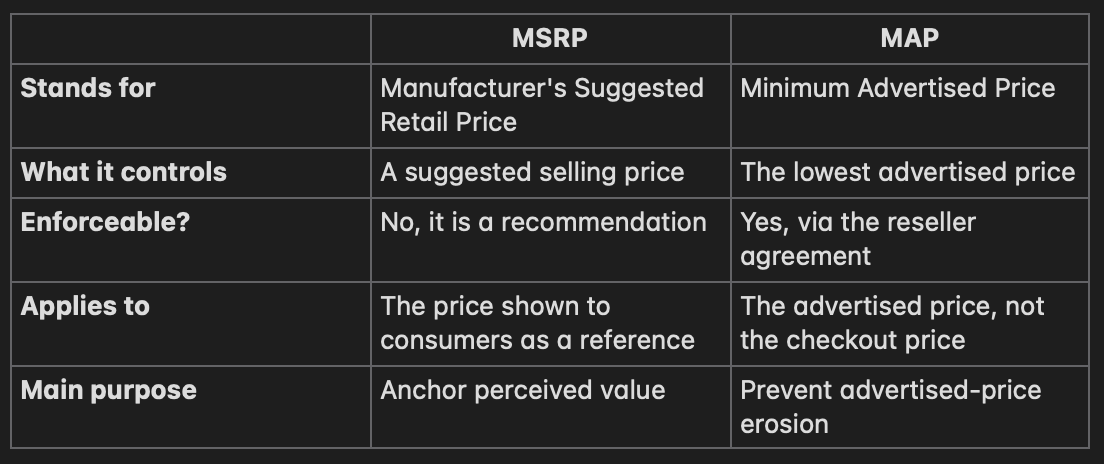
Put simply, MSRP tells the market what a product is worth; MAP stops public discounting from dragging that value down. They are complementary, not interchangeable: most brands set an MSRP as the reference and a MAP as the enforceable floor beneath it, often with MAP set somewhat below MSRP to leave a controlled discount band resellers can compete within.
Is MAP Pricing Legal?
Yes, MAP policies are generally legal in the United States, and the reason comes back to that advertised-versus-actual distinction. Because a MAP policy restricts only the price a reseller may advertise, not the price it actually charges at checkout, it avoids being treated as price-fixing. The Federal Trade Commission enforces the antitrust laws that govern this area, and the key line is between advertised-price policies and setting the actual resale price.
Setting the actual selling price is a different practice called resale price maintenance, which carries materially more legal risk and is scrutinized more closely, including under some stricter state laws. The practical implication for manufacturers is that a MAP policy stays on safe ground as long as it governs advertising, is applied consistently, and is not enforced in a way that effectively dictates the final sale price. This is general information, not legal advice; qualified antitrust counsel should review any MAP policy before you put it in place.
Why Pricing Control Matters
On marketplaces, weak pricing control is where brand value quietly bleeds out. When unauthorized sellers and undisciplined resellers advertise below a brand's intended price, several things happen at once: perceived value drops, authorized retail partners who honor pricing get undercut and lose trust, and the discounting can spiral as sellers race each other to the bottom.
The damage compounds on platforms like Amazon, where price feeds directly into visibility. A seller advertising below MAP can win the Buy Box on price alone, even without offering the same service or legitimacy, which is why removing unauthorized sellers is as much a sales strategy as a protection one. We cover that dynamic in our guide to winning the Amazon Buy Box. A MAP policy is one tool in a broader effort to keep a brand's pricing and presence intact.
Enforcing MAP: Policy is Only Half the Job
Setting a MAP policy is straightforward; enforcing it across every marketplace is the hard part, and it is where most pricing control actually succeeds or fails. A policy only works if violations are caught and addressed consistently, which means monitoring advertised prices across channels, acting on authorized resellers who break the policy, and, for the harder problem, dealing with unauthorized sellers who never agreed to it in the first place.
That unauthorized-seller problem is one MAP alone cannot solve, since a seller who never signed a reseller agreement is not bound by the policy. Addressing them relies on supply-chain control and marketplace brand-protection tools instead, which is a wider discipline than pricing alone, and one we go deeper on in our guide to protecting your brand on marketplaces.
The flip side is the authorized sellers already in your network: when a 3P seller policy drifts out of control, pricing discipline goes with it. Tightening who is allowed to sell what is part of the same work, which we cover in our guide to regaining brand control.
The Bottom Line
MAP and MSRP are not the same tool. MSRP suggests what a product is worth; MAP sets an enforceable floor on how low that price can be advertised. Manufacturers who understand the difference use both together, an MSRP to anchor value and a MAP to protect it, and they treat MAP as a starting point rather than a finished job, because a policy is only as good as its enforcement across every channel. Pricing control is ultimately part of the larger work of protecting a brand's value on marketplaces.
If pricing erosion or unauthorized sellers are a problem for your brand, the practical next step is to audit where your advertised prices are slipping and who is driving it, then decide whether you have the reach to enforce discipline across every channel yourself. Keeping pricing and brand presence intact as you grow is central to marketplace growth, and it is one of the operational problems a partner running your marketplace presence is built to handle.
To see how pricing control fits into running your brand's whole marketplace operation, talk to our team.
Frequently Asked Questions
What is the difference between MAP and MSRP?
MSRP is a suggested selling price and a non-binding reference. MAP is the lowest price an authorized reseller may advertise, and it is enforceable through the reseller agreement. MAP controls advertised price; MSRP only suggests a selling price.
Is MAP pricing legal in the US?
Generally yes, because MAP restricts only the advertised price, not the actual checkout price, which keeps it clear of price-fixing. Setting the actual resale price, known as resale price maintenance, carries more legal risk. This is not legal advice; consult counsel.
Can a retailer sell below MAP?
Yes. MAP only restricts the publicly advertised price. A retailer can sell below MAP through an in-cart or checkout discount, as long as it does not advertise that lower price.
Should MAP be set the same as MSRP?
Usually not. Many brands set MAP somewhat below MSRP, creating a controlled band resellers can compete within while still protecting the publicly advertised price from eroding too far.
Does a MAP policy stop unauthorized sellers?
Not on its own. Unauthorized sellers never agreed to the policy, so they are not bound by it. Controlling them requires supply-chain discipline and marketplace brand-protection measures beyond the MAP policy itself.