What Happens in the First 90 Days With a Marketplace Partner

Signing with a marketplace partner is the easy part. The first 90 days are where the relationship is actually made or broken, because that is the window where the handover happens, the operation stabilizes, and the first real results show up. Brands that know what to expect in that window get through it smoothly; brands that go in blind mistake the normal friction of a transition for a problem. This guide walks through what actually happens in the first three months of working with a marketplace partner, phase by phase, so you know what to prepare, what to expect, and how to tell the engagement is on track.
A quick note on scope. By marketplace partner here we mean a partner that runs your marketplace sales operation, not an agency you hand single tasks to. That kind of partner, often an ecommerce accelerator, takes over listings, pricing, advertising, and fulfillment across channels, which makes the onboarding deeper than a typical vendor setup.
Why the First 90 Days Matter So Much
Across partnerships of almost every kind, the first 90 days are the highest-stakes window: it is when the working relationship is established, the systems are connected, and the partner either proves it can deliver or does not. A marketplace partnership is no different, and arguably more sensitive, because you are handing over a live revenue channel, not starting one from scratch. Mistakes in the transition are visible to customers immediately.
The brands that come through it best treat the first 90 days as a shared project with clear phases and milestones, rather than expecting instant results on day one. Real momentum usually builds in stages, and knowing the shape of those stages is what keeps a normal ramp from feeling like a stall.
Days 1 to 30: Handover and Setup
The first month is groundwork, and how fast it goes depends as much on the brand's responsiveness as on the partner. The focus is transferring everything the partner needs to run the operation and getting the foundations in place. Typically, this phase covers:
- A kickoff and a dedicated point of contact, so there is a clear owner on both sides
- Handover of catalog data, product information, pricing guardrails, and brand assets
- An audit of current marketplace presence: existing listings, account health, pricing, and performance
- Access and integration: connecting the partner's systems to your marketplace accounts and inventory
- In an inventory-backed model, the initial purchase order and inventory moving into the partner's network
The single biggest factor in a smooth first 30 days is how quickly the brand provides access, data, and decisions. A partner cannot move faster than the information it is given, so the brands that prepare their catalog and account access in advance compress this phase meaningfully.
Days 31 to 60: Optimization and Launch
With the foundation in place, the second month is where the partner's work becomes visible. This is the optimization and activation phase, where the groundwork turns into live improvements on your listings and channels. Expect the partner to be:
- Rebuilding and optimizing listings for each marketplace rather than carrying over as-is
- Setting pricing and Buy Box strategy, and beginning to address unauthorized sellers if present
- Launching or restructuring advertising across channels
- Confirming fulfillment is running to each marketplace's speed and service requirements
- Establishing the reporting cadence, so you can see inventory, sales, and performance
This is also where the depth of the model shows. A partner running the full operation is coordinating listings, pricing, advertising, and fulfillment as one system rather than in isolation, which is what allows changes in one area to reinforce the others. The mechanics of how those pieces connect are covered in our guide to how end-to-end ecommerce works.
Days 61 to 90: Momentum and First Results
By the third month, the operation should be stabilizing and the first real results should be emerging. This is the acceleration phase, where early optimization starts showing up in performance and the relationship shifts from setup to ongoing growth. In a healthy engagement, the back half of the first 90 days brings:
- Measurable movement in the metrics that matter: Buy Box share, sales velocity, and in-stock rates
- A first review against the plan agreed at kickoff, with results and next-quarter targets
- A shift from high-touch onboarding to a steady operating rhythm and regular business reviews
- Early signs of the trajectory the partnership is capable of, even if the biggest gains come later
It is worth setting expectations honestly here: 90 days is enough to stabilize the operation and show direction, but the largest gains from a marketplace partnership typically compound over the following quarters. The first 90 days prove the engine runs; the real distance comes after.
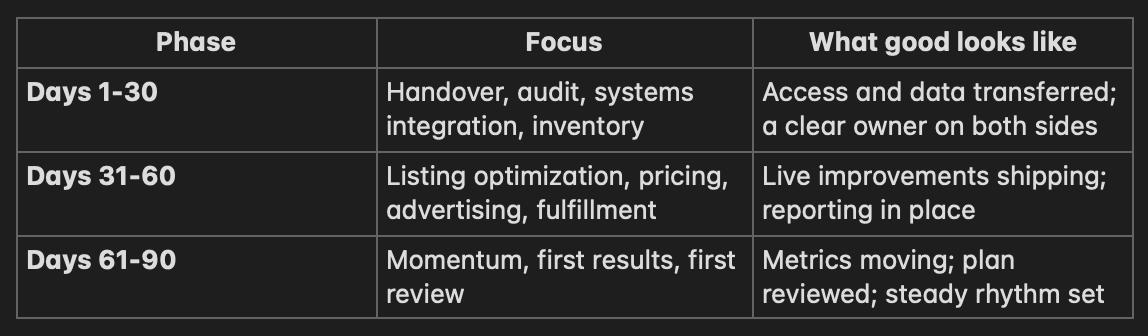
The 30/60/90 Journey at a Glance
How to Tell the First 90 Days are Going Well
Because the biggest results come later, you cannot judge the first 90 days on revenue alone. The better signals are leading indicators that the operation is being run well:
- You have real visibility: clear reporting into sales, inventory, and performance, not just activity updates
- The foundational metrics are trending right: Buy Box share, in-stock rate, and listing quality improving
- Communication is structured: a named contact, a regular cadence, and a review against the original plan
- Problems surface early and get owned, rather than being discovered by you after the fact
What you keep throughout matters too. With the right partner, your products sell under your own brand and you retain ownership and direction while the partner runs the operation, a balance we explore in our guide to handing over your marketplace operation.
The first 90 days with a marketplace partner follow a predictable arc: handover and setup, then optimization and launch, then early momentum and a first review. Knowing that shape is what lets a brand tell the difference between the normal friction of a transition and a genuine problem. Judge the window on leading indicators, visibility, improving foundational metrics, and structured communication, rather than expecting peak revenue in month three, because the biggest gains build from the foundation laid in these first three months.
If you are evaluating a partner and want to understand what a strong onboarding should look like for your brand, it helps to map your own starting point first: your current channel performance, your catalog readiness, and the results you would want to see by day 90. From there you can assess how a marketplace growth partner would run that transition.
The first 90 days are the on-ramp; the destination is the following quarters, which is where a strong ecommerce growth accelerator compounds the foundation it laid during onboarding. To walk through what the first 90 days would look like for your brand, talk to our team.
Frequently Asked Questions
How long does it take to onboard with a marketplace partner?
Initial setup often takes a few weeks from signing to going live, depending on catalog complexity and how prepared your data is. The full first 90 days then cover handover and setup, optimization and launch, and the first results and review.
When should I expect to see results from a marketplace partner?
The first 90 days are mainly about stabilizing the operation and showing direction. Foundational metrics like Buy Box share and in-stock rates should move within that window, but the largest gains typically compound over the following quarters.
What do I need to provide during onboarding?
Catalog and product data, pricing guardrails, brand assets, and access to your marketplace accounts and inventory. How quickly you provide these is the single biggest factor in how fast onboarding goes.
Do I lose control of my brand during onboarding?
No. With the right partner your products continue to sell under your brand, and you keep ownership and strategic direction while the partner runs the day-to-day operation.
What are the warning signs the first 90 days are not going well?
Vague activity reports with no real metrics, no clear point of contact or review cadence, foundational metrics that are not improving, and problems you discover yourself rather than hearing about from the partner first.