What Is an Ecommerce Accelerator? (And How It Differs From an Agency or Aggregator)

The word "accelerator" gets attached to two very different things in ecommerce, and the mix-up is expensive. To some, it means software: a pre-built platform for launching a store quickly. To others, it means a company that buys your inventory and runs your marketplace sales on your behalf. A brand that signs with one expecting the other can lose a year sorting out the mismatch.
This guide covers the second meaning: the ecommerce accelerator as a business partner. You’ll get a plain definition, a clear breakdown of how accelerators differ from agencies and aggregators, and a framework for deciding whether the model fits your brand, including the one capability most comparison articles leave out.
What is an Ecommerce Accelerator?
An ecommerce accelerator is a growth partner that purchases a brand’s inventory at wholesale, then manages and grows the brand’s sales across online marketplaces, handling listings, pricing, advertising, fulfillment, and customer support. Because the accelerator owns the inventory, it earns its return by selling those products successfully, which ties its incentives directly to the brand’s results.
That single detail, the accelerator buys the inventory, is what separates the model from every other kind of ecommerce help. An ecommerce marketplace accelerator isn’t paid to complete tasks. It’s paid when your products sell. This is why the model is often described as an ecommerce growth partner that is inventory-backed: the partner has its own capital on the line.
Importantly, the best accelerators operate under your brand name, not their own. Shoppers see your brand on the listing; the accelerator runs the operation behind it. You keep your brand equity and typically continue selling on your own direct-to-consumer website, while the accelerator takes over the marketplace channels.
How Does an Ecommerce Accelerator Make Money?
An accelerator agrees on a wholesale price with your brand, buys your products outright through a purchase order, and then resells them across marketplaces at a margin. Its profit comes from that margin, so the accelerator only does well when your products actually move. There’s no monthly retainer and no invoice for hours worked.
This is the mechanism behind the “aligned incentives” you’ll hear accelerators talk about. An agency gets paid whether your sales grow or not. An accelerator that has already paid for your inventory has every reason to price competitively, advertise efficiently, and keep products in stock because unsold inventory is its loss, not just yours.
Ecommerce Accelerator vs Agency vs Aggregator
Brands weighing a growth partner usually run into three models, and they’re easy to confuse because they overlap in what they promise, more marketplace sales, while differing completely in how they work. An agency sells services for a fee or retainer: it runs your ads or builds your listings while you keep your inventory, your accounts, and the risk. An aggregator buys your business outright and folds the brand into a portfolio, so control passes to the new owner. An accelerator sits between the two: it buys your inventory rather than your company, then runs the marketplace operation on your behalf and earns a margin only when your products sell. Put simply, the difference comes down to who owns what, your inventory, your brand, and your risk, and how each partner gets paid.
The table below shows how the three models compare at a glance.
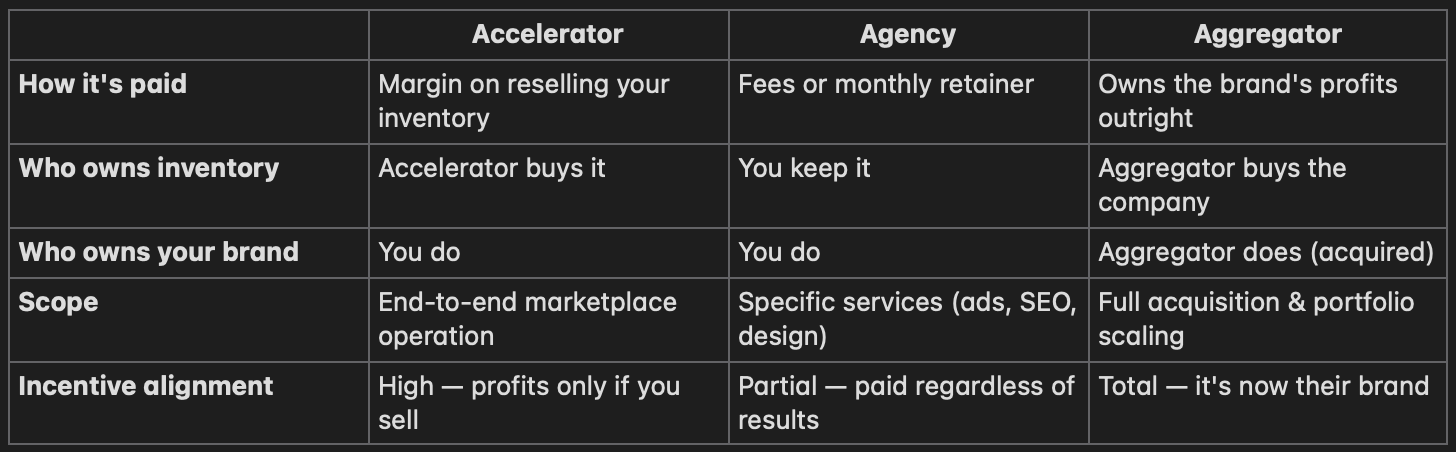
Each model earns its place for a different kind of brand, and the choice has real consequences for control, cost, and growth. You can read Spreetail’s deeper look at the acquisition model in ecommerce accelerators vs. aggregators.
What Does an Ecommerce Accelerator Actually Do?
Once an accelerator owns your inventory, it takes over the full marketplace operation. Capabilities vary by partner, but a full-service accelerator typically handles:
- Demand planning and inventory management, so products stay in stock across channels
- Listing creation, optimization, and content across each marketplace
- Pricing and Buy Box management to stay competitive and visible
- Advertising and marketing across marketplace ad platforms
- Fulfillment and shipping, including fast shipping and Prime-badge eligibility
- Brand and pricing control to limit unauthorized sellers and protect your listings
- Returns, reverse logistics, and customer support
The breadth is the point. Rather than stitching together an agency for ads, a 3PL for shipping, and your own team for everything else, an accelerator runs it as one operation with a single line of accountability.
How to Evaluate an Ecommerce Accelerator
Most comparison articles stop at the definition. The harder question is how to tell accelerators apart, because they differ sharply in capability. Five factors matter most when comparing ecommerce accelerator companies:
- Fulfillment capability, especially for large and bulky products. This is the factor most guides ignore and the one that most often determines success. Standard fulfillment networks penalize oversized and heavy items with high fees and slow transit, and many accelerators simply can’t ship them at Prime speed. If your catalog includes furniture, appliances, fitness equipment, or anything big and bulky, confirm the partner has fulfillment built for big products before anything else.
- Channel coverage. Some accelerators only run Amazon. Others operate across Amazon, Walmart, Target, and 20-plus marketplaces. Broader coverage reduces your dependence on any single channel. Ask which channels the partner actually operates, not just which ones it can name.
- Brand control. Confirm you keep your brand identity, that listings run under your name, and that the partner actively polices unauthorized sellers and pricing. Strong brand control protects the equity you’ve built.
- Global reach. If international growth is on your roadmap, ask whether the accelerator can support marketplace expansion into new regions or is limited to a single country.
- Transparency and reporting. You’re handing over a channel; you should still see what’s happening. Look for real-time reporting into sales, inventory, and performance rather than a monthly slide deck.
When an Ecommerce Accelerator is (and isn’t) the Right Fit
An accelerator fits best when you’re an established brand or manufacturer that wants to grow across marketplaces without building the team, carrying the inventory risk, or stitching together vendors. It’s also a good fit when you’d rather have one partner own the outcome than manage several. It’s especially strong for brands with complex, big-and-bulky products that most partners struggle to ship profitably.
It’s a weaker fit if you want to keep hands-on control of every marketplace decision, if you only need help in one narrow area (an agency is cleaner for that), or if your goal is to sell the company outright (that’s an aggregator). Being honest about this upfront saves everyone a mismatched partnership.
The Bottom Line
An ecommerce accelerator is the right partner when you want marketplace growth without the operational load, and when incentive alignment matters enough that you’d rather work with a partner whose profit depends on selling your products, not on billing you. The model’s real dividing line isn’t the definition; it’s capability, and fulfillment for complex products is where accelerators separate most.
If you're weighing whether the model fits your brand, start with your own catalog and channels: how much operational load you're carrying, how much of it sits in hard-to-ship products, and how much marketplace growth you're leaving on the table. From there, the next step is a conversation about what an end-to-end ecommerce partner could take off your plate.
Frequently Asked Questions
How is an ecommerce accelerator different from an agency?
An agency provides specific services for a fee or retainer while you keep your inventory and carry the risk. An accelerator buys your inventory and runs the whole marketplace operation, earning a margin only when your products sell.
How is an accelerator different from an aggregator?
An aggregator acquires your brand outright and folds it into a portfolio. An accelerator partners with you and buys inventory, not equity, so you keep ownership of your brand and keep building it.
Do ecommerce accelerators take equity in my company?
Typically no. Accelerators invest by purchasing inventory and operating your marketplace channels, not by taking a stake in your business.
Do I keep control of my brand with an accelerator?
Yes. With the right partner your products sell under your brand name and you retain your brand identity and usually your own DTC website. The accelerator runs the marketplace channels behind the scenes.
What types of brands benefit most from an accelerator?
Established brands and manufacturers that want to scale across marketplaces without adding headcount or operational risk, particularly those selling large, heavy, or hard-to-ship products.