How to Sell on eBay: The Complete Guide for Brands

Almost every guide to selling on eBay is written for one kind of seller: the reseller flipping thrift finds, clearing out a closet, or sourcing arbitrage inventory. That advice is fine, but it misses a growing group. eBay is also a serious sales channel for brands and businesses, with roughly 135 million active buyers worldwide, and the playbook for running it as a scalable, branded channel looks very different from flipping a used console for a quick profit.
This guide is written for that second group. It covers how to set up the right kind of eBay account, how eBay's fees actually work, how to build listings that convert, how fulfillment and returns operate, and how to run eBay as one reliable channel in a broader multi-channel strategy rather than a side hustle.
How Selling on eBay Works for a Brand
Selling on eBay as a brand means listing your products, setting your prices, and fulfilling your own orders on a marketplace that owns the customer relationship and charges a percentage of each sale. Unlike the newer curated marketplaces run by Target, Lowe's, or Best Buy, eBay is open: you can register and start listing without an invitation. That openness is its strength and its challenge, since it means enormous reach alongside intense competition.
The critical mindset shift for a brand is this: eBay is not just a place to liquidate overstock or offload returns, though it is excellent for both. Used deliberately, it is a full sales channel where a branded storefront, complete listings, and reliable fulfillment can build a durable presence in front of a huge, purchase-ready audience that already trusts the platform.
eBay Business Account vs. Personal Account
If you are selling as a brand or business, you need an eBay business account, not a personal one. eBay's own policy requires a business account once you are buying or making products to sell regularly rather than occasionally offloading personal items.
A business account matters for three practical reasons:
- Higher selling limits. Personal accounts start with tight caps on listings and monthly sales volume, which a real brand hits almost immediately.
- Branding and eBay Store access. A business account lets you sell under your company name and subscribe to an eBay Store, which unlocks a branded storefront and lower fees.
- Lower fees and better tools. Store subscribers generally pay lower final value fees and get access to advanced tools like bulk listing and Promoted Listings.
How Much Does It Cost to Sell on eBay?
For most categories in 2026, eBay charges a final value fee of about 13.6% of the total sale plus a per-order fee of $0.30 for orders of $10 or less and $0.40 for orders above $10, according to eBay's Seller Center fee documentation. The final value fee is calculated on the full amount, including item price and shipping, and now includes payment processing since eBay moved to managed payments.
The other costs to plan for:
- Insertion (listing) fees. Your first 250 listings each month are typically free; beyond that, roughly $0.35 per listing, whether or not the item sells.
- Category variation. Rates vary by category, from single digits in some categories to around 15 percent in others like books and media.
- Store subscription discounts. An eBay Store subscription lowers per-sale fees and adds free listings, which pays off at volume.
- Promoted Listings. Optional advertising, charged as a percentage of the sale only when a promoted item sells.
- Performance penalties. Accounts rated Below Standard, or with high 'item not as described' return rates, can face additional fees, which is a strong incentive to keep quality and service high.
Selling on eBay vs. Amazon and Walmart
For brands already on other channels, eBay's distinct value is a large, deal-oriented audience, permissive category rules, and a genuine customer relationship, traded against a marketplace known more for resale than brand-building.
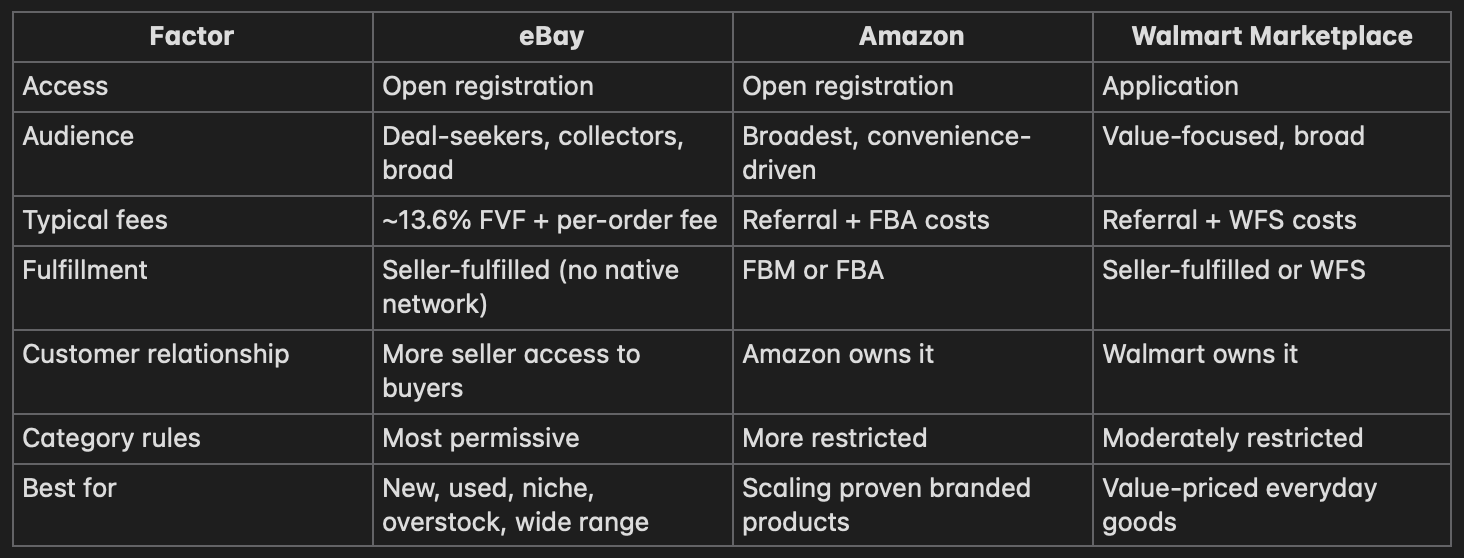
The takeaway: eBay is rarely a brand's only channel, but it is a valuable one, especially for reaching deal-seekers, moving overstock profitably, testing products, and selling categories other marketplaces restrict.
How to Start Selling on eBay: Step by Step
Getting a brand set up on eBay is straightforward once you know the sequence:
- Create a business account. Register with your business details and complete eBay's verification, including banking information for managed payouts.
- Subscribe to an eBay Store. Choose a store tier that matches your listing volume to unlock branding, lower fees, and free listings.
- Build your listings. Create complete, keyword-accurate listings with strong images and full item specifics. Bulk-listing tools or an integration help at scale.
- Set fulfillment and return policies. Configure handling time, shipping options, and a clear return policy, which directly affect visibility and seller status.
- Launch and monitor performance. Go live, then track your seller metrics, since eBay rewards consistent performance with better placement and lower fees.
eBay Listing Optimization: Getting Found and Converting
eBay's search engine, Cassini, rewards listings that are complete, accurate, and likely to convert. Because eBay is a search-driven marketplace with billions of listings, listing quality is the single biggest lever a brand controls.
Focus your optimization here:
- Titles. Use the full character allowance with natural, specific keywords buyers actually search, leading with brand, product, and key attributes.
- Item specifics. Complete every item-specific field. These power eBay's filters and search, and incomplete specifics quietly suppress visibility.
- Images. Use multiple high-resolution photos on clean backgrounds; eBay has minimum image standards and rewards rich visual detail.
- Pricing and format. For brands, fixed-price (Buy It Now) listings usually beat auctions; competitive pricing and free shipping thresholds improve placement.
- Structured, keyword-rich descriptions. Answer buyer questions directly and mobile-first, since most eBay traffic is on mobile.
Fulfillment, Returns, and Performance on eBay
eBay has no native fulfillment network like Amazon FBA or Walmart WFS, so you handle your own storage, shipping, and returns. That independence is a double-edged sword: you keep control and margin, but your operational performance is entirely on you, and eBay ties visibility and fees directly to it.
Three performance realities every brand should plan around:
- Handling time affects ranking. Fast, accurately stated handling times improve search placement and buyer trust.
- Return rate affects fees. A high 'item not as described' return rate can trigger extra fees, so listing accuracy directly protects margin.
- Seller status compounds. Top-Rated Sellers earn fee discounts and better visibility; Below Standard sellers pay penalties and lose placement.
The Overstock Angle Brands Underuse
Here is a use for eBay that the reseller guides never mention to brands: it is one of the few channels where excess, returned, and open-box inventory can be sold profitably instead of written off, because the deal-seeking audience actively wants exactly that kind of stock. The catch is on the back end. Every unit you recover has to be inspected, graded, relisted, and reshipped, and that grading-and-relisting work scales far less easily than shipping new product does. The volume involved is easy to underestimate. In 2025 alone, Spreetail moved hundreds of thousands of returned items back through its reverse-logistics operation. For a brand sitting on overstock, the real question is not whether eBay can sell it, but whether your returns-and-recovery process can keep up once it does.
Common eBay Selling Mistakes (and How to Avoid Them)
Most eBay problems for brands trace to a handful of avoidable mistakes. Here are the ones to watch for.
- Using a personal account: Hits selling limits, no branding or Store.
- Fix: Register a business account from the start.
- Incomplete item specifics: Listings buried in filtered search.
- Fix: Complete every item-specific field at listing.
- Auctions by default: Unpredictable pricing, thin margins.
- Fix: Use fixed-price listings for branded goods.
- Ignoring seller metrics: Below Standard status adds fees, cuts visibility.
- Fix: Monitor the seller dashboard and protect your rating.
- Inaccurate listings: High 'not as described' returns and extra fees.
- Fix: Describe condition and specs precisely.
- Treating it as a dumping ground: Missed revenue from a real sales channel.
- Fix: Run a branded Store with complete, optimized listings.
How to Grow on eBay
Growing on eBay rewards consistency and smart use of its brand tools. The sellers who scale treat eBay like a real channel, not a clearance bin, and increasingly like an ecommerce growth accelerator that feeds the rest of their business rather than a place to dump leftovers.
Build out a branded eBay Store, expand your catalog into adjacent categories where your brand has authority, use Promoted Listings to amplify proven items, and lean on eBay's tools for repeat business, such as store newsletters and coupons, since eBay gives sellers more direct buyer access than most marketplaces. The mistake brands make is running eBay in isolation. Its pricing, its inventory, and its fulfillment promises all need to line up with what you are doing on Amazon, Walmart, and your own site, or the inconsistencies start costing you, in buyer trust, in accidental price gaps, in stranded stock. Getting eBay to pull in the same direction as your other channels is less about eBay itself and more about how you run marketplace growth and multi-channel expansion as a single coordinated effort.
eBay is one of the largest and most permissive marketplaces in the world, but the winning approach for a brand looks nothing like the reseller playbook that dominates most eBay advice. Set up a business account and a branded Store, build complete and accurate listings, run reliable fulfillment, and use eBay's deal-seeking audience to reach buyers and recover overstock revenue that would otherwise be lost. Treat it as a real channel rather than a clearance bin, and eBay becomes a durable, profitable part of your multi-channel mix.
Frequently Asked Questions
Do I need a business account to sell on eBay?
If you are selling as a brand or buying products to resell regularly, yes. eBay's policy requires a business account for commercial selling, and it gives you higher limits, company-name branding, eBay Store access, and lower fees.
Is selling on eBay worth it for a brand?
It can be. eBay offers roughly 135 million active buyers, permissive category rules, and more direct customer access than Amazon or Walmart. It is especially valuable for reaching deal-seekers, moving overstock profitably, testing products, and selling categories other marketplaces restrict.
What sells best on eBay?
eBay is strong across new, used, refurbished, niche, collectible, and overstock inventory. For brands, it is particularly effective for products that benefit from a deal-seeking audience and for recovering value from returned or excess stock.
Does eBay handle fulfillment like Amazon FBA?
No. eBay has no native fulfillment network, so sellers handle their own storage, shipping, and returns, or use a third-party fulfillment partner. Your fulfillment performance directly affects your search visibility and seller status.
How do I improve my eBay search ranking?
eBay's Cassini search rewards complete, accurate, conversion-friendly listings. Fill in all item specifics, use keyword-rich titles, add strong images, price competitively, keep handling times fast, and maintain a strong seller rating.