How to Sell on Lowe's Marketplace: The Complete Seller Guide

Lowe's quietly opened its marketplace to third-party sellers in December 2024, an industry first for home improvement. Yet most brands still can't get a straight answer on how it actually works, largely because "selling on Lowe's" points to three different programs that get tangled together: the new Lowe's Marketplace, the traditional wholesale supplier relationship, and the installation contractor network.
This guide is about the first one, the marketplace, where approved brands list and sell their own products on Lowes.com while keeping control of their inventory and pricing. Because the platform is barely a year old, it's one of the rare moments when a major retailer's marketplace is still open territory rather than a crowded field. Below, we cover how it works, whether your brand qualifies, how to apply, what it costs, how fulfillment works, and how to scale.
What Is Lowe's Marketplace?
Lowe's Marketplace is Lowe's third-party online marketplace, launched in December 2024 and powered by marketplace technology provider Mirakl, where approved sellers list their products on Lowes.com alongside Lowe's own assortment and fulfill orders themselves. According to Lowe's own seller page, marketplace products appear in search and browse results next to Lowe's stocked products, clearly labeled as "sold and shipped by a third-party seller."
This is a genuine shift for Lowe's. Rather than buying and stocking every product itself, Lowe's now relies on verified third-party sellers to broaden its digital assortment across categories like furniture, kitchen and bath, home décor, and power and hand tools. For brands, it means access to a Fortune 50 home-improvement retailer's audience without needing Lowe's to purchase your inventory wholesale.
How Selling on Lowe's Actually Works
Before going further, it helps to separate three things people often confuse when they search for how to sell on Lowe's:
- Lowe's Marketplace (third-party selling). You keep ownership of your inventory, list it on Lowes.com, set your price, and ship orders yourself. Lowe's takes a commission on each sale. This guide covers this route.
- Lowe's supplier or vendor (first-party wholesale). Lowe's buys your product wholesale and sells it as its own inventory, potentially in stores. This runs through Lowe's merchandising organization, not the marketplace, and is a different application entirely.
- Lowe's contractor or service provider (installation trades). This is for tradespeople who want to perform installations or services for Lowe's customers. It has nothing to do with selling products online.
If your goal is to sell your products to Lowe's shoppers while keeping control of your catalog and inventory, the marketplace is the route you want.
Lowe's Marketplace vs. Amazon and Walmart
For brands already selling on other channels, the fastest way to understand Lowe's Marketplace is by contrast. The core difference is curation and category focus: Lowe's is a vetted, home-improvement-focused marketplace, while Amazon and Walmart are broader and more open.
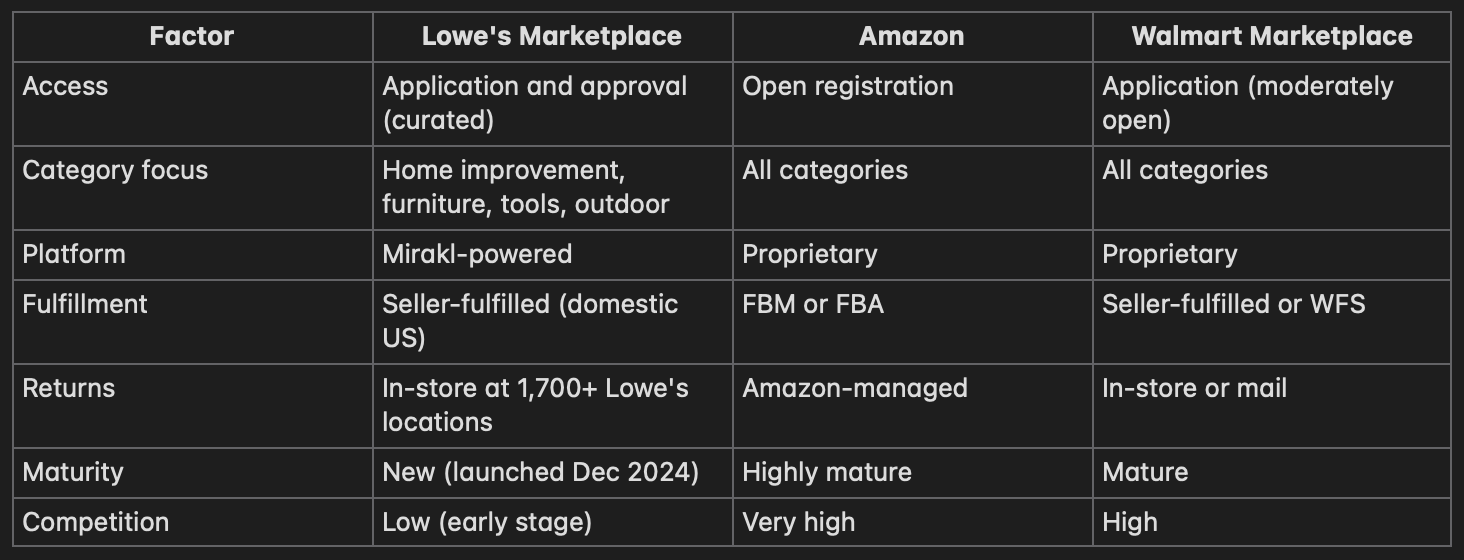
The takeaway: Lowe's Marketplace trades the massive reach of Amazon for a curated, high-intent home audience and an early-mover advantage while category pages are still thin.
Is Selling on Lowe's Marketplace Worth It? Benefits and Trade-offs
For brands in home improvement, furniture, tools, and outdoor categories, Lowe's Marketplace offers a high-intent audience and an early-mover advantage on a new platform. For brands outside those categories, it is not a fit.
The case for selling on Lowe's Marketplace:
- A high-intent home-improvement audience. Lowe's serves roughly 16 million customer transactions a week, and marketplace products sit right alongside its own assortment.
- Early-mover advantage. Because the marketplace launched in December 2024, category pages are still less saturated than on mature marketplaces, so early sellers can accumulate reviews and ranking signals ahead of later arrivals.
- In-store returns at 1,700+ locations. Customers can return marketplace purchases at any Lowe's store, a convenience most pure-play marketplaces cannot match.
- Loyalty integration. Marketplace purchases earn MyLowe's Rewards points, tying your products into Lowe's broader customer ecosystem.
The trade-offs:
- It is curated, not open. Lowe's carefully selects sellers, so approval is not guaranteed.
- Home categories only. If your catalog falls outside Lowe's home-improvement focus, it will not be accepted.
- Sellers are excluded from promotions by default. You are not automatically part of Lowe's promotional events, though you can opt in through your account manager.
- Early-stage tooling. As a new platform, its seller tools and advertising options are less developed than Amazon's or Walmart's.
Lowe's Marketplace Seller Requirements
Lowe's does not publish an exhaustive checklist, but its seller pages and onboarding documentation point to a clear set of requirements:
- A US-based business with domestic inventory. Lowe's Marketplace currently supports sellers shipping domestic inventory from within the US, with no international shipping at launch.
- Products within Lowe's available categories. Your catalog must fall within the home-improvement categories Lowe's Marketplace supports, such as furniture, kitchen and bath, home décor, and tools.
- Compliance with product-attribution requirements. Sellers can only load products that meet Lowe's product-attribution standards, meaning complete, structured product data.
- Self-fulfillment capability. You store inventory and ship orders yourself, so reliable fulfillment is essential.
- Alignment with Lowe's brand and quality. Lowe's selects sellers and monitors ongoing performance and product ratings to ensure alignment with its standards.
- Non-duplicative assortment (for existing vendors). Existing Lowe's vendors can sell on the marketplace if selected and if their products are not duplicative of Lowe's existing assortment.
How to Become a Lowe's Marketplace Seller
Becoming a Lowe's Marketplace seller follows a clear, approval-based process. According to Lowe's Marketplace seller information, it works in three main stages:
- Submit an application. You apply through Lowe's Marketplace. Once approved, Lowe's sends you an invitation to join.
- Review the agreement and upload products. You review the marketplace agreement and upload your product information, populating the required attributes using Lowe's product import template in the Mirakl portal.
- Final review and go live. Lowe's does a final review before your products go live on the site, after which you begin fulfilling orders.
Because the marketplace is curated rather than open, having clean product data and a catalog that fits Lowe's categories ready before you apply improves both your odds and your speed through onboarding.
How Lowe's Marketplace Works With Mirakl: Integration and Catalog Setup
Lowe's Marketplace runs on Mirakl, the platform that also powers marketplaces for retailers like Macy's, Nordstrom, and Best Buy. In practice, this means you manage your catalog, orders, inventory, and performance data through the Mirakl portal on Lowes.com.
Setup centers on your product feed. You download the Lowe's-specific product import template, populate the required attributes for each listing, and upload the completed file in the Mirakl portal. If there are errors, Mirakl generates a downloadable feedback file showing row-specific issues to correct and re-upload. New sellers are typically assigned a Seller Management Specialist who recommends starting with your top-performing items and can help review validation issues during your first uploads. One practical advantage of the Mirakl foundation: if you already sell on another Mirakl-powered marketplace, much of your catalog and account infrastructure can carry over, which speeds up onboarding.
Listing and Product Content Optimization on Lowe's Marketplace
Lowe's shoppers buy home-improvement products by specification, so complete, accurate product data is the foundation of visibility on the marketplace. Lowe's explicitly requires products to meet its product-attribution standards, which means listing completeness is not optional, it is a condition of being listed at all.
Optimize your listings around these priorities:
- Complete product attribution. Populate every required attribute field accurately. Incomplete data can block your products from going live and reduces their visibility in search and browse.
- Specification accuracy. Dimensions, materials, and compatibility details matter to project-driven home-improvement buyers and reduce returns.
- Clear, descriptive titles. Lead with the details shoppers search, such as brand, product type, size, and material, rather than keyword-stuffed copy.
- Strong imagery. Use high-quality images that show the product clearly and in context, which is especially important for furniture and larger home items where scale matters.
Because your products appear right next to Lowe's own assortment, content quality is what makes your listing competitive on the same page.
Fulfillment, Returns, and Pricing on Lowe's Marketplace
Lowe's Marketplace is a seller-fulfilled model. You store inventory and ship orders yourself from within the US, and international shipping is not supported at launch. Returns, however, are a standout advantage: customers can return marketplace purchases to any of Lowe's 1,700-plus stores nationwide, which lowers purchase friction for shoppers.
On pricing, you set your own prices across the value-to-premium spectrum, and marketplace sellers are excluded from Lowe's promotional events by default. If you want to participate in promotions, you opt in through your account manager and can run tools like strikethrough pricing through Mirakl. Because you control price and absorb your own fulfillment costs, build your margin with shipping, returns, and the Lowe's commission already factored in.
For home-improvement brands specifically, fulfillment is where margins are won or lost. Many products in Lowe's categories are large, heavy, or freight-class items, and oversized shipping, damage rates, and return logistics are far more complex than small-parcel fulfillment.
Where a Fulfillment Partner Fits
This operational reality is why some brands scaling on Lowe's Marketplace work with a partner that specializes in large, heavy, and hard-to-ship products rather than building oversized logistics in-house. Spreetail, for example, focuses on this kind of big-and-bulky ecommerce, operating 2.74M square feet of warehouse space and processing more than 735,000 returned items through reverse logistics in 2025. Its fulfillment services built for big products and track record growing home and outdoor brands across marketplaces speak to the freight, delivery, and returns challenges that define home-goods fulfillment. For brands weighing whether to handle oversized Lowe's fulfillment themselves or lean on specialized infrastructure, that distinction is worth thinking through early.
What Does It Cost to Sell on Lowe's Marketplace?
Selling on Lowe's Marketplace costs a commission on each sale, with no setup or monthly seller fees. Based on the commission range Mirakl publishes for its retail marketplaces, Lowe's commission is typically in the 8 to 15 percent range depending on product category. Beyond commission, you absorb your own fulfillment and shipping costs, since the model is seller-fulfilled.
When modeling your Lowe's economics, combine the category commission, your fulfillment and shipping costs, and expected return rates to understand your true all-in cost before setting prices.
Common Lowe's Marketplace Mistakes (and How to Avoid Them)
Most Lowe's Marketplace problems trace to a handful of avoidable mistakes. Here are the ones to watch for.
- Applying to the wrong program. Time wasted in the vendor or contractor track.
- Fix: Confirm you want third-party selling, then apply through Lowe's Marketplace.
- Thin product attribution. Products blocked from going live or buried in search.
- Fix: Complete every required attribute before uploading.
- Duplicating Lowe's assortment. Existing-vendor products rejected.
- Fix: Offer products that expand, not duplicate, Lowe's catalog.
- Underpricing without modeling costs. Margin erodes after commission and freight.
- Fix: Build commission, shipping, and returns into your price.
- Treating it like Amazon. Over-indexing on ads instead of data quality.
- Fix: Prioritize complete, accurate listings; the platform rewards it.
- No big-and-bulky plan. Oversized orders cannot be fulfilled profitably.
- Fix: Line up freight and oversized capability before listing large items.
How to Scale on Lowe's Marketplace
Scaling on Lowe's Marketplace rewards being early and operationally consistent. Because the platform is still new, sellers who establish strong listings and reviews now can build a ranking position that later arrivals will struggle to displace.
Start with your top-performing, spec-complete SKUs, ideally in categories closest to Lowe's assortment gaps like home, tools, and outdoor, then expand systematically once those listings perform. Maintain complete product attribution and reliable fulfillment as you add volume, and keep your pricing and brand presentation consistent across every channel you sell on. Because Lowe's is one channel in a broader home-goods strategy, the brands that scale best keep it aligned with their other marketplaces. For a wider view, see how Spreetail approaches multi-channel marketplace expansion across platforms, and why building beyond a single marketplace protects long-term growth.
Frequently Asked Questions
Is Lowe's Marketplace open to anyone?
No. Lowe's Marketplace is curated. Because it is focused on home improvement, Lowe's carefully selects sellers to ensure products align with its brand and strategy. You apply, and if approved, you receive an invitation to join.
How do I become a Lowe's Marketplace seller?
You submit an application through Lowe's Marketplace. Once approved, you receive an invitation, review the marketplace agreement, upload your product information through the Mirakl portal, and go live after a final review. Then you fulfill orders yourself.
How is Lowe's Marketplace different from becoming a Lowe's supplier?
On the marketplace, you keep ownership of your inventory, list on Lowes.com, and ship orders yourself while Lowe's takes a commission. As a supplier, Lowe's buys your product wholesale and sells it as its own inventory. They are separate programs with separate applications.
Can existing Lowe's vendors sell on the marketplace?
Yes. Existing Lowe's vendors can sell on the marketplace if they are selected and if the products they list are not duplicative of Lowe's existing assortment.
Is selling on Lowe's Marketplace worth it?
For home-improvement, furniture, tools, and outdoor brands, it offers a high-intent audience, in-store returns, and an early-mover advantage on a new platform. For brands outside Lowe's home categories, it is not a fit.