International Marketplace Expansion: Taking Established Brands Global

For an established brand, going global rarely fails because of demand. The products sell; shoppers in other countries want them. It fails on operations: the duties and taxes nobody modeled, the per-country compliance rules, the local fulfillment that does not exist yet, and the returns that become a logistical puzzle the moment a package has to cross a border. A brand can be ready for international growth in every way that shows up on a strategy deck and still stall on the machinery of actually shipping, charging, and supporting customers abroad.
This guide approaches international marketplace expansion for brands as the operational challenge it really is, and looks at why many established brands choose a partner-led path rather than building the international apparatus themselves. If you want the groundwork on evaluating and researching a new market, our guide to unlocking global markets covers that preparation; this piece is about executing the move without building a new operation in every country.
Why Established Brands Expand Internationally
The pull is straightforward: international markets are a large and fast-growing pool of demand that most US-focused brands have barely touched. Cross-border ecommerce is expanding faster than domestic ecommerce and now accounts for a significant share of global online sales, according to Capital One Shopping research, with a majority of global shoppers already buying from retailers outside their home country.
For an established brand that has saturated its domestic channels, that demand is often the clearest remaining path to growth. Expanding to a new country can also diversify revenue and reduce dependence on the US market, in the same way adding domestic channels reduces dependence on a single marketplace. The logic that drives brands to expand beyond Amazon extends naturally across borders.
Why International Expansion is an Operational Problem
Entering a new country is not like adding a new domestic channel. The strategy work, deciding which market and how to position, is the visible part. The operational work underneath it is where established brands actually get stuck, and it is specific to crossing borders:
- Duties, tariffs, and import costs. Every border adds landed-cost complexity. Getting duties and tariffs wrong quietly erodes margin or prices you out, and the rules differ by country and product category.
- Tax and regulatory compliance. VAT, GST, and country-specific registration, labeling, and product rules each require local knowledge, and getting them wrong carries real penalties.
- Local fulfillment and delivery. Shipping from the US is slow and expensive, and increasingly uncompetitive against local sellers. Meeting local delivery expectations usually means holding inventory in-country, which means building or renting a network abroad.
- Cross-border returns. A return that has to travel back across a border, or be handled locally, is far more complex and costly than a domestic one, and a weak returns experience kills repeat purchases.
- Currency, payments, and listings. Local currencies, payment methods, languages, and marketplace-specific listing requirements all have to be handled per market, not once.
Each of these is manageable alone. The difficulty is that international expansion requires all of them at once, per country, before the first order ships. That is why so many established brands have the demand and the ambition to go global but stall on the execution, and why the question quickly becomes whether to build that apparatus or bring in someone who already has it.
Build the International Operation or Expand with a Partner?
Established brands going global face the same build-versus-partner decision they face domestically, but the stakes are higher because the operational gap is wider. Building it yourself means standing up fulfillment, compliance, and support in each new country, a multi-year investment before the market proves out. A partner-led model compresses that.
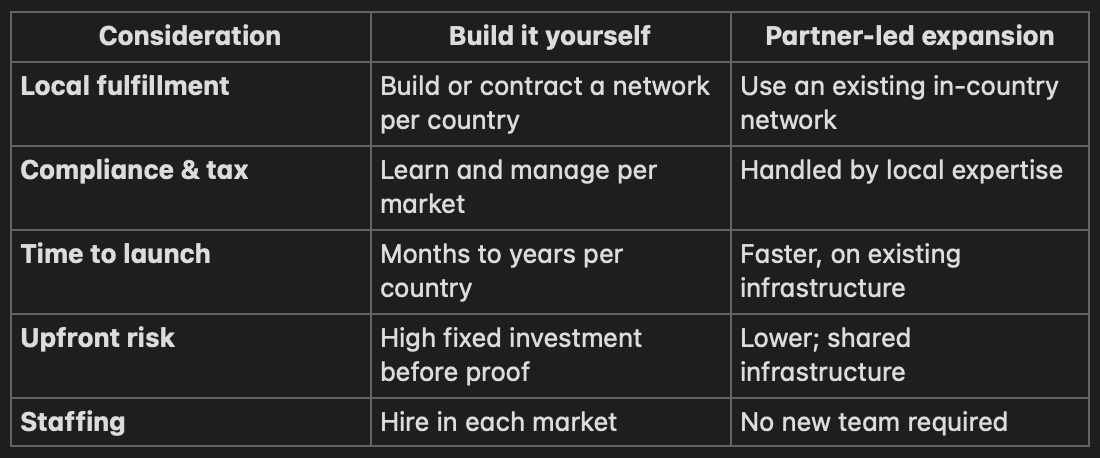
This is the real meaning of selling in more countries without adding a headcount for each one. Rather than replicating your operation abroad, a partner that already runs fulfillment, compliance, and marketplace management in the target region lets you expand on infrastructure that exists. For the broader framework of sequencing new channels and markets, our marketplace expansion roadmap lays out how to decide what to add and when.
Where Established Brands Usually Start
International expansion works best in sequence, not all at once. Most established brands begin with the markets that are operationally and culturally closest, then expand outward as each proves out. Canada is a common first step for US brands because of its proximity, shared language, and similar consumer behavior, which is why we cover expanding into Canada as its own entry point. Europe is often the next major frontier, offering large, high-value markets but also the most per-country complexity in compliance and fulfillment.
The principle is the same whichever market comes first: prove demand in one country, get the operation right, then use that foundation to expand to the next rather than attempting several simultaneously. An ecommerce growth accelerator with an established multi-country network makes sequencing easier, because each new market is an extension of existing infrastructure rather than a standing start.
For established brands, international marketplace expansion is won or lost on operations, not ambition. The demand abroad is real and growing, but capturing it means solving duties, taxes, compliance, local fulfillment, and cross-border returns in every market you enter. The brands that go global successfully are the ones that treat expansion as an operational build, then decide honestly whether to construct that machinery themselves or expand on infrastructure that already exists.
If global growth is on your roadmap, start by mapping the operational gap: where would you need local fulfillment, what compliance would each market require, and how returns work across borders. From there you can weigh building versus a marketplace expansion partner that already operates in your target regions.
That evaluation is also where partner-led marketplace growth shows its value, since a networked operation can run several countries as one rather than as separate projects.
Frequently Asked Questions
What is the hardest part of international marketplace expansion?
Usually the operational side: duties and taxes, per-country compliance, local fulfillment, and cross-border returns. Demand is rarely the problem for an established brand; executing the logistics and compliance per market is.
Do I need a local entity or warehouse to sell internationally?
It depends on the market and how competitive you need to be. Shipping from the US is often too slow and costly to compete with local sellers, so holding inventory in-country, directly or through a partner, is frequently necessary to meet local delivery expectations.
How can a brand expand internationally without hiring a team in each country?
By expanding through a partner that already operates fulfillment, compliance, and marketplace management in the target region, you use existing infrastructure instead of building and staffing your own in every market.
Which international market should an established brand enter first?
Most US brands start with the operationally closest markets, often Canada, then move to larger but more complex regions like Europe. Sequencing one market at a time is more reliable than launching several at once.
Is international expansion worth it for established brands?
For brands that have saturated domestic channels, international markets are often the clearest remaining growth path and a way to diversify revenue, provided the operational execution is handled well.