End-to-End Ecommerce vs. Traditional Ecommerce: Key Differences Explained

First, a clarification, because the phrase “traditional ecommerce” gets used two ways. Sometimes it means selling online instead of in a physical store. That is not the comparison here. In this context, traditional ecommerce means the common way brands run their online operation: piece by piece, stitching together a fulfillment provider, an advertising agency, a listing tool, and an in-house team to hold it all together. End-to-end ecommerce is the alternative to that patchwork, where one partner runs the entire operation as a single system. This guide compares those two operating models and where each one fits.
The Core Difference: One Operation vs. a Patchwork
The defining difference is not what gets done, since both models cover the same functions, but how the operation is structured and who is accountable for the result. In traditional ecommerce, the brand is the general contractor. It selects and coordinates each vendor, owns the handoffs between them, and carries the risk when something falls through a gap. In end-to-end ecommerce, one partner runs the whole operation and owns the outcome, while the brand keeps its products and its identity.
Everything else flows from that structural difference. Accountability, cost model, speed, and how growth works all change depending on whether the operation is unified or assembled from parts.
End-to-End vs. Traditional Ecommerce: Side by Side
The clearest way to see the difference is across the dimensions that actually affect a brand's results.
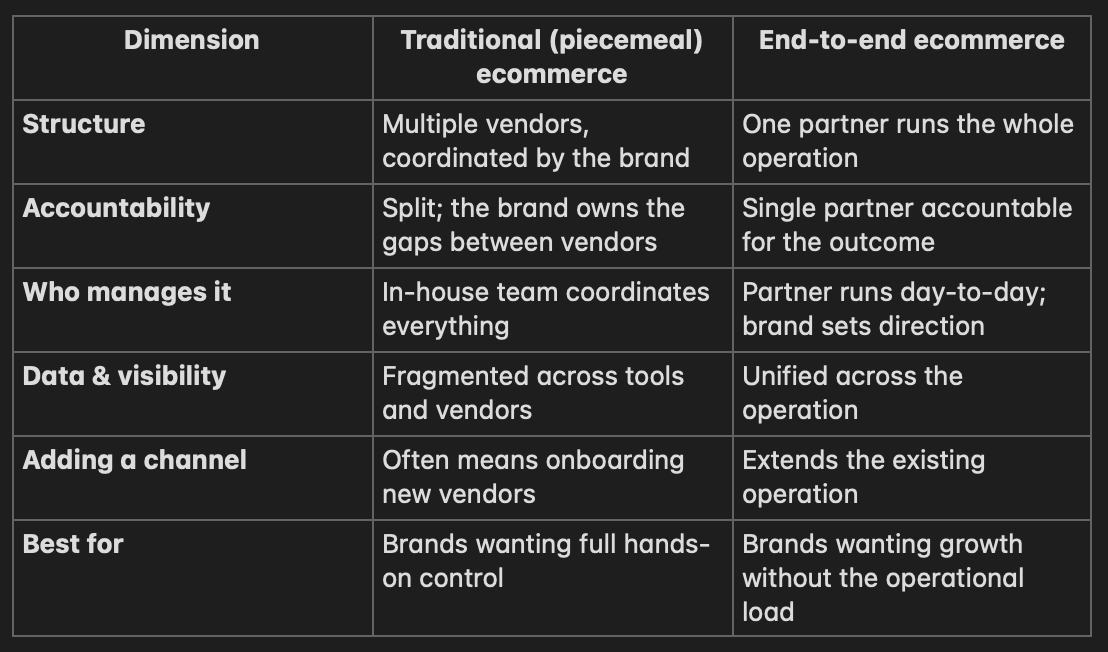
Where the Two Models Really Diverge
A table shows the contrasts; the reasons behind them are what matter when choosing. Three differences carry the most weight.
Accountability. In a traditional setup, a late delivery can be the 3PL's fault, the forecasting tool's, or the agency's, and sorting out whose problem it is takes time the customer does not give you. End-to-end puts one partner on the hook for the whole result, which removes the finger-pointing but means trusting that partner with more of the operation.
The cost model. Traditional ecommerce usually means paying each vendor separately, often on retainers or fees that are owed regardless of results. End-to-end models are frequently structured so the partner is paid in a way tied to actual sales, which aligns incentives differently. The benefits of end-to-end ecommerce go deeper on how that alignment plays out.
How growth works. Adding a marketplace in a traditional setup can mean finding and onboarding new vendors for that channel. In an end-to-end model, a new channel is an extension of the operation already running, which is why the model scales across channels more smoothly.
Which Model is Right for Your Brand?
Neither model is universally better; they suit different situations. Traditional, piecemeal ecommerce fits when you want hands-on control of every decision, have the in-house team to coordinate vendors well, or need only one or two specialized services rather than a whole operation. Many brands run this way successfully, especially earlier in their growth. For a closer look at what moving away from that patchwork actually involves, our guide to handing over your marketplace operation walks through the shift.
End-to-end fits when the coordination itself has become the bottleneck: when managing vendors is pulling focus from the core business, when channel growth keeps requiring new providers, or when you would rather have one partner accountable for results than assemble and oversee the parts yourself. It is a particularly common move for established brands that have the demand to grow across channels but not the desire to build a large in-house ecommerce operation. Ecommerce is now well over a trillion dollars a year in US retail alone, according to the U.S. Census Bureau, and competing across its channels is a bigger operation than it used to be.
End-to-end and traditional ecommerce are not different sets of tasks; they are different ways of structuring the same operation. Traditional means the brand coordinates a patchwork of vendors and owns the gaps between them. End-to-end means one partner runs the operation and owns the outcome. The right choice comes down to whether you want hands-on control of the parts or a single accountable system, and whether coordinating vendors is still serving your growth or starting to hold it back.
If the patchwork is beginning to cost you more than it saves, the next step is to weigh what consolidating it would change. You can see how a unified model works through full service ecommerce solutions, or talk to our team to map it against your current setup.
Frequently Asked Questions
What is the difference between end-to-end and traditional ecommerce?
Traditional ecommerce runs the operation piece by piece, with the brand coordinating separate vendors for fulfillment, advertising, and more. End-to-end ecommerce unifies those functions under one partner accountable for the whole operation.
Does traditional ecommerce mean selling in a physical store?
Not in this context. Here traditional ecommerce refers to the piecemeal operating model of running online sales through multiple separate vendors, as opposed to the unified end-to-end approach, not to brick-and-mortar retail.
Is end-to-end ecommerce more expensive than traditional?
It depends on the model. Traditional setups pay each vendor separately, often regardless of results, while end-to-end models are frequently tied to sales. Total cost depends on how fragmented and how well-coordinated the current operation is.
Can I switch from a traditional setup to end-to-end?
Yes. Many brands move to end-to-end once coordinating multiple vendors becomes a drag on growth. The shift consolidates functions that were previously split across providers into one operation.
Is traditional ecommerce ever the better choice?
Yes. For brands that want full hands-on control, have strong in-house coordination, or need only a narrow service rather than a whole operation, a traditional, piecemeal approach can be the right fit.