Oversized Fulfillment Costs: What Drives the Price and How to Lower It

Two products can weigh the same and cost very different amounts to fulfill. Fulfillment cost for oversized goods is driven less by the number on the scale and more by density, dimensions, freight class, and how the item reaches the customer's door. That is why a single blended rate quote is almost useless for a brand selling large products: your real cost depends on the specific characteristics of what you ship, not just its weight.
This breakdown walks through what actually drives the cost of oversized product fulfillment, why those costs vary so much from one product to the next, and the levers that lower them. If you already know why oversized goods need a different operation, this is the companion piece on what that operation costs. For the underlying mechanics, see our guide to why oversized products break standard ecommerce logistics.
What Drives the Cost of Oversized Fulfillment?
The cost of fulfilling a large or heavy product is the sum of several components, most of which a standard pick-and-pack quote never surfaces. Understanding each one is how you compare an oversized product fulfillment company on total cost rather than a headline rate. Six components drive the bill:
- Freight class (NMFC). Items moving by freight are assigned a class based on density, stowability, handling, and liability. Lower-density items like assembled furniture land in higher, more expensive classes, as defined by the National Motor Freight Traffic Association.
- Dimensional weight. Carriers bill on the greater of actual or volume-based weight, so a light-but-large item is charged as if it were much heavier. For bulky goods, volume usually sets the price.
- Oversize and handling surcharges. Once an item passes a carrier's size or weight thresholds, additional-handling and large-package surcharges stack on top of the base rate.
- Shipping mode: parcel vs LTL freight. Items roughly over 150 pounds or 108 inches typically leave the parcel network for less-than-truckload (LTL) freight, which carries its own cost structure and accessorial fees.
- Last-mile and white-glove delivery. Room-of-choice delivery, assembly, and debris removal are specialized services that add meaningful cost for furniture and appliances in particular.
- Storage, handling, and returns. Bulky items consume far more warehouse space, and their returns require inspection, repackaging, and restocking that small parcels do not.
The single most important idea here is freight class. As the National Motor Freight Traffic Association defines it, an item's NMFC class is set by density and handling characteristics, not weight alone, which is exactly why two same-weight products can cost very different amounts to ship.
Why Oversized Fulfillment Costs Vary By Product
The reason two large products can cost very different amounts comes down to a handful of physical characteristics: density, fragility, and the type of delivery they need. A dense, durable item is cheaper to move than a light, fragile, awkward one, even at the same weight. To make that concrete, it helps to look at a few everyday examples, such as furniture, appliances, and fitness equipment, which sit at different points on each of these factors:
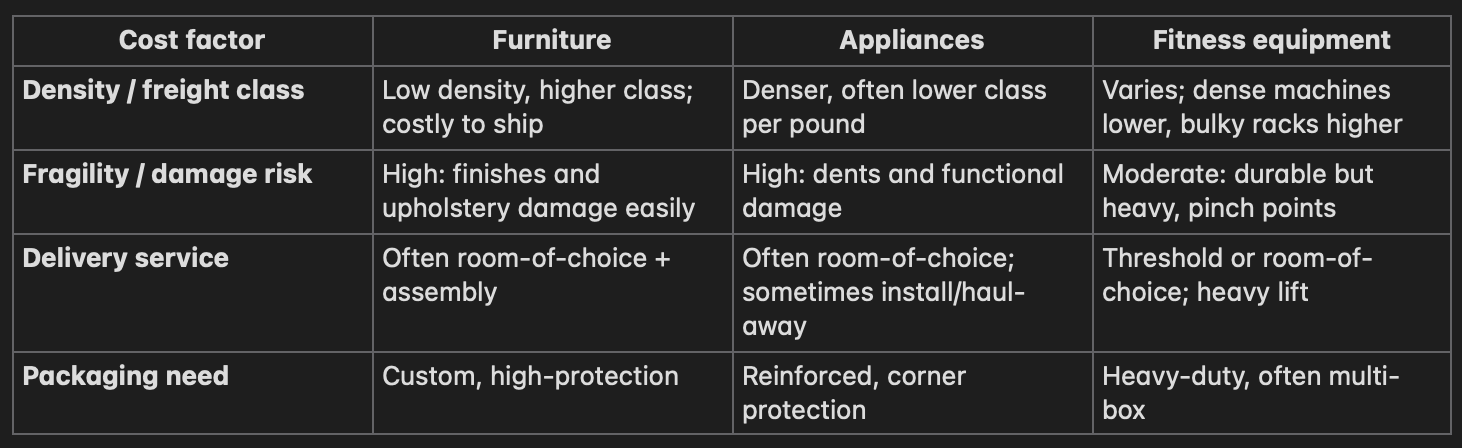
The takeaway is not about any one category. It is that cost tracks the underlying characteristics, not the label: a low-density, fragile item occupies volume, climbs into higher freight classes, and needs careful packaging and premium delivery, while a dense, durable item is cheaper to classify and move even when it is heavy. Any brand selling a mix of large products, which is the reality of most multichannel heavy product fulfillment, needs a partner that prices each item on its real profile rather than applying one blended rate across the catalog.
The Amazon Factor: FBA Oversize Fees
For brands selling on Amazon, FBA adds its own cost layer for large items. Amazon tiers fulfillment fees by size, from small and large standard up through oversize and special oversize, with fees rising sharply at each tier, and it charges inbound placement and removal fees on top. As Amazon Seller Central documents, oversized items also carry higher inbound shipping costs, and removal fees for unsold oversized stock can rival the original fulfillment cost. For slow-moving large products, those storage and removal fees are often the hidden driver of a bad margin.
This is a major reason brands with oversized catalogs weigh alternatives to pure FBA, including partners that can offer fast shipping on large items without Amazon's oversize fee structure. The right model depends on your mix of channels and how much of your catalog is genuinely oversized.
How to Lower Oversized Fulfillment Costs
You cannot make a sofa small, but you can stop overpaying to ship it. The levers that actually move oversized fulfillment cost:
- Right-size and optimize packaging to reduce dimensional weight and damage claims at once
- Confirm freight classifications are accurate, since misclassified items quietly overpay on every shipment
- Position inventory near demand to shorten expensive freight lanes and speed delivery
- Consolidate volume with a partner that negotiates carrier discounts you cannot reach alone
- Match delivery service to the product, so you are not paying for white-glove where threshold delivery suffices
- Watch inventory velocity on large SKUs to avoid storage and removal fees on slow movers
Most of these are hard to execute alone, which is why brands with meaningful oversized volume turn to an oversized fulfillment solution built for large goods rather than a generalist network that treats them as exceptions. For how selection criteria beyond price should guide that choice, see our guide on how to choose an ecommerce fulfillment partner.
Oversized fulfillment cost is not one number; it is a stack of components that behave differently for furniture, appliances, and fitness equipment. Brands that treat it as a single blended rate tend to overpay on their highest-volume products and misprice their catalog. The ones that stay profitable understand their freight classes, their dimensional-weight exposure, and where delivery service is adding cost they do not need.
If you sell large or heavy products, the useful next step is to break your own catalog down the way this article does: which SKUs are low-density and climbing into high freight classes, where dimensional weight is inflating your bill, and which items genuinely need white-glove delivery. With that picture, you can evaluate a large item fulfillment solution on total cost and category fit, or explore what oversized fulfillment built for scale looks like across channels. Talk through your catalog when you are ready to compare.
Frequently Asked Questions
How much does oversized product fulfillment cost?
It depends on the product's density, freight class, dimensions, shipping mode, and delivery service, not weight alone. Two same-weight items can cost very different amounts, so compare total cost modeled on your actual SKUs rather than a blended rate.
Why is fulfilling large items so expensive?
Oversized items are billed on dimensional weight, assigned higher freight classes when low-density, trigger carrier surcharges, often shipped by LTL freight, and may need white-glove delivery. Higher damage and storage costs add more.
What is freight class and why does it matter?
Freight class is an NMFC rating based on density, stowability, handling, and liability. It heavily influences LTL shipping cost, which is why accurate classification can meaningfully lower what you pay.
Is FBA cost-effective for oversized products?
FBA tiers fees by size and adds inbound and removal fees, so oversized items can carry high total costs, especially if they sell slowly. Many brands with large catalogs evaluate alternatives that fit oversized goods better.
Why do two large products of the same weight cost different amounts to fulfill?
Because cost tracks density, fragility, freight class, and delivery type, not weight alone. A light but bulky, fragile item usually costs more to move than a dense, durable one of the same weight, so each product should be priced on its own profile.