How to Sell on Wayfair: The Complete Guide to Getting Approved and Growing

Most guides on how to sell on Wayfair get one crucial thing wrong: they call it a marketplace and describe it like Amazon. It is not. Wayfair operates a wholesale supplier model, where you sell your products to Wayfair at a base cost, and Wayfair sells them to customers at a retail price it sets. Understanding that distinction is the difference between a profitable Wayfair business and a frustrating one.
This guide covers how selling on Wayfair actually works, whether your brand qualifies, how to apply, how the base-cost pricing model affects your margins, how fulfillment works through dropship and CastleGate, the real costs most sellers overlook, and how to scale once you are live.
How Selling on Wayfair Actually Works
Wayfair is not an open marketplace in the Amazon or Walmart sense. It operates a supplier and dropship model where Wayfair functions as your buyer: you list products through Wayfair's supplier platform, and when a customer orders, Wayfair sends you the purchase order and you ship directly to the customer. According to Wayfair's own supplier guidance, drop-shipping is Wayfair's primary method of fulfillment: the customer orders on Wayfair's site, and Wayfair sends the purchase order directly to your warehouse to pick, pack, and ship.
This matters because it changes everything about how you price, forecast, and manage margin compared with a true third-party marketplace.
The Base-Cost Model: Who Sets the Price
On Wayfair, you set your base cost, the wholesale price at which you sell each product to Wayfair. Wayfair then covers the cost of shipping to the customer and sets the retail price on its site. You are paid your base cost, and Wayfair keeps the difference between that and the retail price as its margin.
The practical implication: you do not control the price the customer sees, and you cannot use retail-price promotions the way you would on Amazon. Your lever is your base cost, and your margin is built there. This is the single most important concept for any brand learning how to sell on Wayfair.
Selling on Wayfair vs. Amazon and Walmart
For brands already on other channels, the fastest way to understand Wayfair is by contrast. The core difference is the commercial model: Wayfair buys wholesale and sets retail, while Amazon and Walmart are open marketplaces where you set your own retail price and pay per-sale fees.
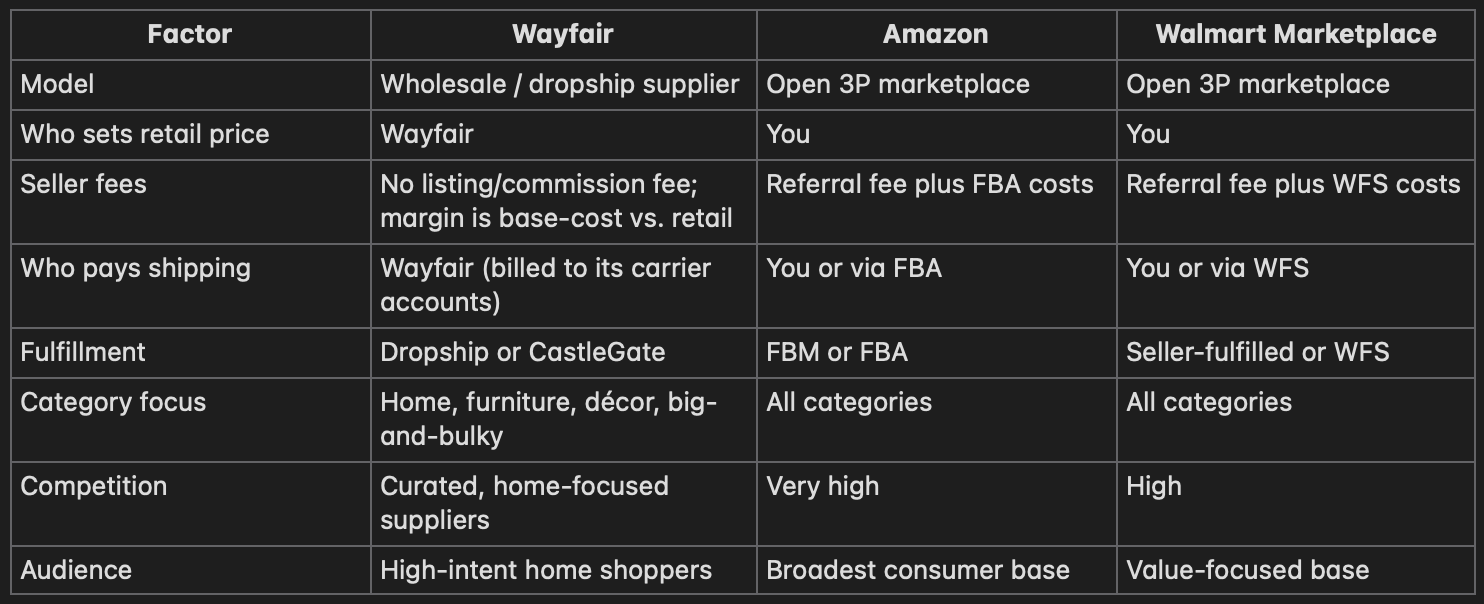
The takeaway: Wayfair trades your pricing control for access to a large, high-intent home-goods audience and a built-in logistics network. That is a good trade for the right brand and a poor one for brands that depend on retail-price control.
Is Selling on Wayfair Worth It? Benefits and Trade-offs
For brands in furniture, home décor, and big-and-bulky categories, Wayfair offers access to a large, high-intent audience without per-sale commission fees. For brands that need retail-price control or sell outside home categories, it can be a poor fit.
The case for selling on Wayfair:
- A concentrated, high-intent home audience. Wayfair shoppers arrive looking for furniture and home goods, which supports higher average order values than general marketplaces.
- No per-sale commission or listing fees. Your margin is built into your base cost rather than eroded by referral fees.
- Wayfair pays the shipping. Because freight bills to Wayfair's carrier accounts, the logistics cost that makes big-and-bulky products expensive to sell elsewhere sits with Wayfair, not you.
- Strong big-and-bulky fit. Wayfair's customer base and delivery infrastructure are built around large home items, a category most marketplaces handle poorly.
The trade-offs:
- You lose retail-price control. Wayfair sets the customer-facing price, which limits promotional strategy and can create channel-pricing tension.
- Margin lives in a fixed base cost. If you price your base cost wrong, there is no per-order lever to recover margin later.
- Payment terms are longer. Standard terms are Net 60, which affects cash flow unless you opt into Quick Pay (at a fee).
- Narrow category fit. Wayfair is home-goods only, and several product types are excluded outright.
Wayfair Seller Requirements: Do You Qualify?
Wayfair does not publish an exhaustive checklist, but its supplier onboarding and FAQ point to a clear set of requirements:
- A registered business with legal business information and tax ID
- Banking details to receive payouts
- Commercial product liability insurance (a certificate of insurance, or COI)
- Dropship capability, meaning the ability to pick, pack, and ship orders reliably
- A warehouse or third-party logistics partner based in North America (or the relevant region you sell in)
- Compliance with Wayfair's Supplier Code of Conduct
- A catalog within Wayfair's home categories: furniture, décor, rugs, kitchen, outdoor, pet
- An order-management process using Partner Home or EDI/API integration
One requirement sellers overlook: not every home product is eligible. Wayfair states it does not carry certain categories, including exercise and cardio machines, medical devices, bicycles, skateboards, power tools, and computer hardware and software, among others. Confirm your catalog is eligible before investing time in the application.
How to Apply and Become a Wayfair Partner
Unlike the invite-only model some guides describe, Wayfair operates a self-serve supplier application. You begin at the Wayfair supplier application, where you submit your company details, tax ID, banking information for payouts, and proof of product liability insurance. Wayfair reviews the application and responds with next steps, and having your business registration information ready helps you move through setup quickly.
After the initial review, you sign Wayfair's dropship agreement, upload your insurance, and configure your inventory feed. Once your Partner Home account is set up, you can build your product listings and go live. Brands with clean product data and integration capability ready move through onboarding faster.
How to Integrate With Wayfair: Partner Home, EDI, and API
Once approved, you manage your Wayfair business through Partner Home, Wayfair's supplier dashboard for orders, inventory, catalog, and performance reporting. For order and inventory data to flow reliably, most suppliers connect through automated integration. According to a Wayfair supplier integration guide, Wayfair supports three integration methods (EDI, API, and the Partner Home portal), with EDI remaining the most established and widely used for exchanging purchase orders, shipment confirmations, and inventory updates.
Here is how the three integration methods differ:
- EDI (Electronic Data Interchange). The long-established standard for exchanging business documents in a fixed, automated format. Your system and Wayfair's exchange purchase orders, shipment confirmations, and inventory updates automatically, with no manual entry. It is the most widely used method among established suppliers and the best fit for higher order volumes, though it typically requires an EDI provider or internal technical setup.
- API (Application Programming Interface). A more modern, flexible connection that lets your systems and Wayfair's exchange data in real time. APIs suit suppliers who want faster, more granular control over inventory and order syncing and have the development resources to build and maintain the connection.
- Partner Home portal. Wayfair's manual, web-based option. You log in to Partner Home and manage orders, inventory, and catalog directly in the dashboard, with no integration to build. It is the simplest way to start and works well for lower order volumes, but it becomes time-consuming to manage by hand as you scale.
Before you begin, get three things in order: clean, standardized product data with accurate dimensions; a decision on whether you will use EDI/API or manage through the portal; and a real-time inventory sync process to prevent overselling. Handled well, integration runs quietly in the background. Handled poorly, it produces stockouts, late shipments, and the chargebacks that follow.
Listing and Product Content Optimization on Wayfair
Wayfair shoppers buy furniture and home goods they cannot touch, so listing completeness and imagery carry unusual weight. Wayfair itself constructs product names from the details you provide and recommends high-resolution imagery of at least 1000 x 1000 pixels with a mix of environmental and silo shots. Optimize around what a home-goods buyer needs to make a confident purchase:
- Imagery: Use multiple high-resolution images per product: a clean silo image plus lifestyle shots that show the item in a real room and at scale. For furniture, scale context reduces returns.
- Dimensions and specifications: Complete every dimensional and material field. Incomplete specs are a leading cause of returns and lost search visibility on a platform where fit and size drive the decision.
- Titles and descriptions: Because Wayfair builds product names from your attributes, provide precise, complete details (material, color, size, style) rather than keyword-stuffed copy.
- Attributes: Populate all available attribute fields so your products surface correctly in Wayfair's faceted, filter-driven search.
Accuracy here is not just a visibility lever. On big-and-bulky home items, it directly reduces the return and damage rates that eat into your net payment.
Fulfillment on Wayfair: Dropship vs. CastleGate
Wayfair offers two fulfillment paths. Dropship is the default: you store inventory and ship directly to customers when Wayfair sends the purchase order. CastleGate is Wayfair's warehousing and fulfillment network, where you send inventory into Wayfair's warehouses, and Wayfair stores, picks, packs, and ships, enabling faster delivery and improved search placement at the cost of storage and handling fees. Many suppliers use a hybrid approach: CastleGate for bestsellers and oversized items where speed matters, dropship for long-tail products.
A key economic point in your favor: with either path, shipping is billed to Wayfair's carrier accounts (Small Parcel via FedEx, LTL, or White Glove), not to you. You coordinate pickups, but the freight cost sits with Wayfair. For big-and-bulky home products specifically, this materially changes the economics compared with marketplaces where you pay to ship. Still, the operational side (freight coordination, white-glove delivery, damage rates, and return logistics) is far more complex than for small parcels, and getting it wrong erodes the base-cost margin you carefully set.
Where a Fulfillment Partner Fits
This operational complexity is why some brands scaling on Wayfair work with a partner that specializes in large, heavy, and hard-to-ship products rather than building oversized logistics in-house. Spreetail, for example, focuses on exactly this kind of big-and-bulky ecommerce. Its fulfillment services built for big products and its track record growing home and outdoor brands across marketplaces speak to the freight, delivery, and returns challenges that define home-goods fulfillment. For brands weighing whether to handle oversized Wayfair fulfillment themselves or lean on specialized infrastructure, that distinction is worth thinking through early.
The Real Cost of Selling on Wayfair: Base Cost, Payment Terms, and Fees
Wayfair charges no listing fee and no per-sale commission, but that does not mean selling on Wayfair is free of cost. Your economics are shaped by three things beyond your base cost:
- Base-cost margin. Because Wayfair pays your base cost and sets retail itself, your entire profit is built into how you set that base cost. Price it too low and there is no recovery mechanism.
- Payment terms and Quick Pay. According to Wayfair's supplier payment terms, standard payment is Net 60, meaning you are paid within 60 days of the invoicing date. Wayfair also offers a Quick Pay option ("2% 30 net 60"): you can be paid within 30 days in exchange for a 2% fee. Factor that fee into your base cost if cash flow matters.
- Returns and damage. Return costs and damage claims are common on big-and-bulky items and reduce your net payment, so build a realistic return-rate assumption into your base-cost math.
Notably, one cost that burdens sellers on other channels is absent here: shipping. As covered above, Wayfair bills freight to its own carrier accounts, which is a meaningful advantage for oversized home goods.
Common Wayfair Selling Mistakes (and How to Avoid Them)
Most Wayfair problems trace to a handful of avoidable mistakes. Here are the ones we see most often.
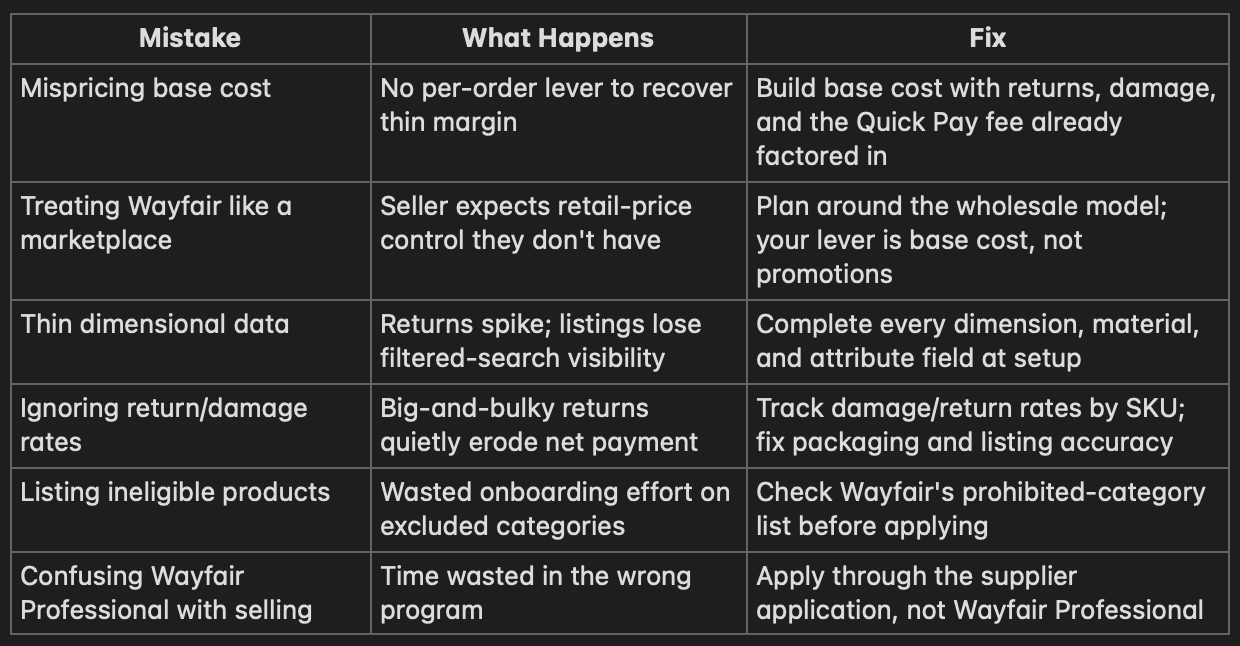
Wayfair Professional vs. Selling on Wayfair: Don't Confuse Them
These are two different things, and conflating them is a common mistake. Selling on Wayfair means becoming a supplier whose products Wayfair sells. Wayfair Professional is Wayfair's business-to-business program for trade customers (interior designers, contractors, and businesses) purchasing home goods at trade pricing. If you searched "Wayfair Professional requirements" hoping to sell, you are looking at the wrong program: Wayfair Professional is about buying on trade terms, not selling your catalog. To sell, use the supplier application covered above.
How to Scale on Wayfair
Scaling on Wayfair rewards catalog breadth and operational consistency. Wayfair explicitly encourages suppliers to provide their full product assortment within its categories, because broader assortment reaches more customers, so once your bestsellers are proven, expand systematically rather than holding back.
Use CastleGate for your fastest-moving and oversized items to improve delivery speed and placement, plan inventory around seasonal peaks and flagship events like Way Day, and keep your base-cost pricing, content quality, and fulfillment reliability consistent as volume grows. Because Wayfair is one channel in a broader home-goods strategy, the brands that scale best keep it aligned with their other marketplaces. For a wider view, see how Spreetail approaches multi-channel marketplace expansion across platforms.
Frequently Asked Questions
Is Wayfair a marketplace or a retailer?
Neither in the usual sense. Wayfair operates a wholesale and dropship supplier model: you sell products to Wayfair at a base cost, and Wayfair sells them to customers at a retail price it sets. It is not an open third-party marketplace like Amazon where you set your own price and pay per-sale fees.
Who sets the price on Wayfair, me or Wayfair?
You set your base (wholesale) cost. Wayfair sets the retail price shoppers see and keeps the difference as its margin. You do not control the customer-facing price.
Do I pay for shipping when selling on Wayfair?
No. Orders are billed to Wayfair's Small Parcel (FedEx), LTL, or White Glove carrier accounts. You coordinate pickups, but Wayfair covers the freight cost, a notable advantage for large, heavy home goods.
How does payment work on Wayfair?
Standard payment terms are Net 60, meaning you are paid within 60 days of the invoicing date. Wayfair also offers Quick Pay ("2% 30 net 60"), letting you be paid within 30 days for a 2% fee.
Do I need insurance to sell on Wayfair?
Yes. Wayfair requires commercial product liability insurance and a certificate of insurance (COI). It is a standard policy most providers offer, and any broker can issue the COI once your policy is bound.
What's the difference between selling on Wayfair and Wayfair Professional?
Selling on Wayfair means becoming a supplier whose products Wayfair sells. Wayfair Professional is a B2B program for trade buyers (designers, contractors, businesses) to purchase at trade pricing. One is about selling; the other is about buying.
Is selling on Wayfair worth it?
For furniture, décor, and big-and-bulky home brands, yes. It offers a high-intent audience, no per-sale commission, and Wayfair-covered shipping. For brands that need retail-price control or sell outside home categories, the loss of pricing control and the Net 60 terms may outweigh the benefit.