How to Sell on Walmart Marketplace Without an In-House Team

A lot of manufacturers make a great product and still stall on Walmart Marketplace, not because the opportunity is weak but because running the channel well is a full-time operation they are not staffed for. Listings, pricing, fulfillment, advertising, and account health each demand ongoing attention, and a factory floor is not an ecommerce team. The question these brands are really asking is not how the Walmart algorithm works. It is who is going to run all of this when we do not have the people to.
This guide answers that. It covers what selling on Walmart actually takes operationally, why manufacturers in particular hit a capacity wall, and how multi-channel marketplace management for manufacturers lets a brand grow on Walmart, and beyond, without hiring a department. If you want the tactical playbook for ranking and Buy Box, that lives in our complete Walmart Marketplace growth guide; this piece is about who executes it.
What Does it Take to Run Walmart Marketplace?
Selling on Walmart is not a set-and-forget listing. It is a standing operation with several functions that each need continuous work, which is exactly why it overwhelms a brand without dedicated staff. The ongoing workload breaks down into:
- Catalog and listing management: building, correcting, and maintaining product data as it changes
- Pricing and Buy Box monitoring: adjusting to stay competitive without eroding margin
- Inventory and fulfillment: keeping in stock and meeting Walmart's delivery-speed expectations
- Advertising: setting up, funding, and optimizing campaigns on an ongoing basis
- Account health and compliance: resolving suppressed listings and performance flags before they cost ranking
- Customer service and returns: handling post-purchase issues within Walmart's standards
None of these is a one-time task. They run every week, across every SKU, and the channel is now big enough that doing them poorly is expensive: Walmart Marketplace hosts well over 200,000 active third-party sellers, so an under-managed catalog simply gets outcompeted by brands that treat the channel as a full operation.
Why Manufacturers Hit a Capacity Wall
Manufacturers and established brands are often excellent at making and sourcing products and deliberately lean everywhere else. That structure is efficient for production and a poor fit for marketplace operations, where the work is daily, specialized, and spread across disciplines that rarely exist under one roof in a manufacturing business.
Three gaps show up again and again. First, headcount: hiring a marketplace specialist, an ads manager, and fulfillment support is a real investment before the channel has proven out. Second, expertise: each marketplace has its own rules and rhythms, and generalist staff cannot keep pace with all of them. Third, attention: a channel managed in whatever time is left over after the core business rarely gets the consistency it needs. The result is a strong product that underperforms its potential, which is what sends brands looking for Walmart marketplace management services in the first place.
Build In-House or Bring in a Partner?
There is no universally right answer, only the right answer for your situation. The honest way to decide is to weigh what building the capability in-house would cost against what a managed partner provides, before defaulting to either.
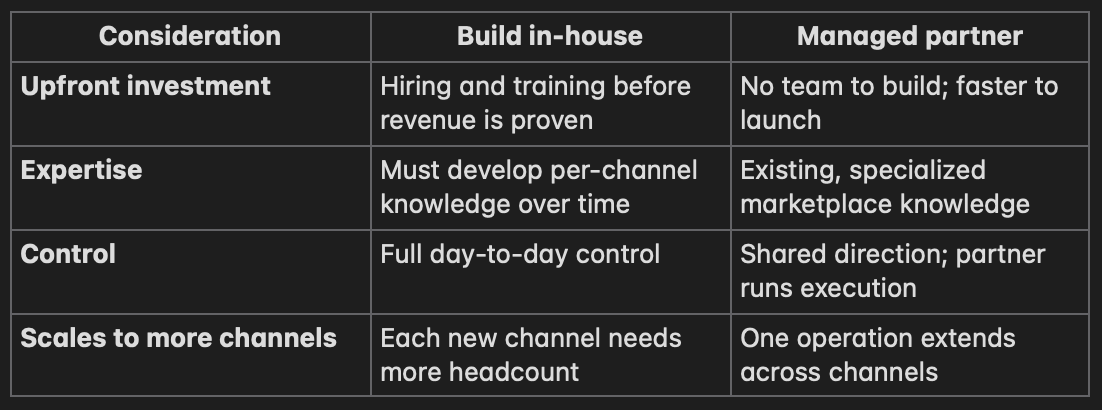
Keeping it in-house makes sense when marketplaces are central to your strategy and you intend to build that muscle permanently. A partner makes sense when you want the channel to run well now, without diverting capital and focus from the core business, and especially when Walmart is only the first of several channels you plan to reach.
What Walmart Marketplace Management Looks Like
A done-for-you model means a partner takes over the standing operation listed earlier and runs it on your behalf, under your brand. Rather than hiring and directing a team, the partner supplies the people, the per-channel expertise, and the day-to-day execution, while you keep ownership of the brand and a say in strategy. This is the model an ecommerce growth accelerator is built around, where the partner buys into your success rather than billing you for hours.
If the accelerator model is new to you, it is worth understanding how it differs from a traditional agency, which we break down in what an ecommerce accelerator is. The short version: you do not have to execute Walmart's mechanics yourself, because the partner does, and is accountable for the outcome.
The practical difference is accountability. Instead of a strong product quietly stalling because no one has time to manage the channel, a single partner is responsible for whether the Walmart business actually grows. For the specifics of ranking, listing quality, and Buy Box that a partner should be executing on your behalf, the mechanics are detailed in our Walmart growth guide.
Walmart Isn't the Only Channel
Most manufacturers do not want to stop at Walmart. They are also on Amazon, eyeing Target, or planning to add more channels as they grow. Managing each one as a separate project, with separate tools and separate learning curves, is how the capacity problem multiplies instead of resolving.
This is why the real solution is usually multi-channel rather than Walmart-only. Running Walmart alongside Amazon marketplace growth services and other channels as one coordinated operation means inventory, pricing, and performance are handled together rather than fought separately, which is the premise of managed marketplace growth across platforms.
For brands mapping that journey, our roadmap for scaling beyond Amazon lays out which channels to add and in what order.
The underlying point holds: a brand that plans to grow across platforms is better served by a partner built for marketplace expansion from the start than by standing up a new in-house process for every channel it adds.
Selling on Walmart Marketplace without an in-house team is not only possible, it is how many manufacturers run the channel: by handing the standing operation to a partner instead of building a department for it. The decision is less about whether you can learn Walmart's mechanics and more about whether running them, every week, across every SKU, and eventually across several channels, is the best use of your team.
If you are weighing the move, start by being honest about capacity: do you have the people, the per-channel expertise, and the attention to run Walmart well on an ongoing basis, and to repeat that for the next channel. If the answer is no, a managed, multi-channel model is worth evaluating against the cost of building in-house. To see what running Walmart and your other channels as one operation could look like, talk to our team.
Frequently Asked Questions
How much does Walmart marketplace management cost?
It varies by model. Agencies typically charge fees or retainers, while some operators work on other commercial terms. Compare the total cost against what hiring and running an in-house team would cost, not just the headline fee.
How long does it take to get selling on Walmart?
Approval timelines vary by category and application completeness, often a couple of weeks for U.S. businesses. A managed partner can handle the application and setup so the process does not stall on internal bandwidth.
Can I sell on Walmart and keep my Amazon business running?
Yes. Most brands run both, and managing them together is usually more efficient than treating each as a separate operation. Coordinated multi-channel management keeps inventory and pricing aligned across platforms.
Do I lose control of my brand with a managed partner?
No. A managed model runs the day-to-day execution under your brand while you keep ownership of your brand identity and a say in strategy and pricing.
Is a managed partner only worth it for large manufacturers?
No. The deciding factor is whether you have the in-house capacity and expertise to run the channel well, not your size. Smaller brands without a dedicated team often benefit most.