Marketplace Expansion Services: A Roadmap for Brands Ready to Scale Beyond Amazon

Most brands treat expansion beyond Amazon as a copy-and-paste exercise: take the Amazon listings, port them to Walmart or Target, and wait for a second revenue stream to appear. It rarely does. Each marketplace has its own algorithm, its own fulfillment rules, its own buyer, and its own definition of a good listing. What made you a winner on Amazon can quietly make you invisible somewhere else. Expansion is not a copy job; it is a sequence of channel-specific launches, and the order and readiness you bring to it decide whether it pays off.
This roadmap covers when a brand is actually ready to expand, which channels to add and in what order, and how marketplace expansion services reduce the operational risk of scaling across multiple platforms at once. For the case on why diversification matters in the first place, see our companion piece on why brands must expand beyond Amazon.
What are Marketplace Expansion Services?
Marketplace expansion services are offerings that help a brand launch and grow on new sales channels beyond its primary marketplace, covering channel strategy, listing setup and optimization, fulfillment, advertising, and ongoing management for each platform. Rather than a brand building expertise for every marketplace in-house, an expansion partner supplies the platform-specific knowledge and operations required to launch correctly and scale.
The value is not just execution; it is sequencing and avoiding the mistakes that make new channels underperform. A good marketplace expansion partner tells you not only how to launch on a channel, but whether you are ready and which channel to add next.
When is a Brand Ready to Expand Beyond Amazon?
Expanding too early is a common and expensive mistake. New channels pull attention, inventory, and capital away from the channel that is already working. Before adding a marketplace, most brands should be able to answer yes to these readiness checks:
- Your primary channel is stable and profitable, not still being fixed
- You have inventory and working capital to stock a second channel without starving the first
- Your fulfillment can absorb another channel's orders and service-level requirements
- You have the bandwidth, in-house or through a partner, to manage a distinct operation per channel
- There is evidence of demand for your category on the target marketplace
If your Amazon business is still leaking margin or stocking out, fix that first. Expansion amplifies both strengths and weaknesses, so a shaky foundation gets more expensive, not less, when spread across channels.
Which Marketplace Should You Expand to First?
There is no universal order, but the right sequence depends on your category, your margins, and where your buyers already are. The major channels each suit different brands:
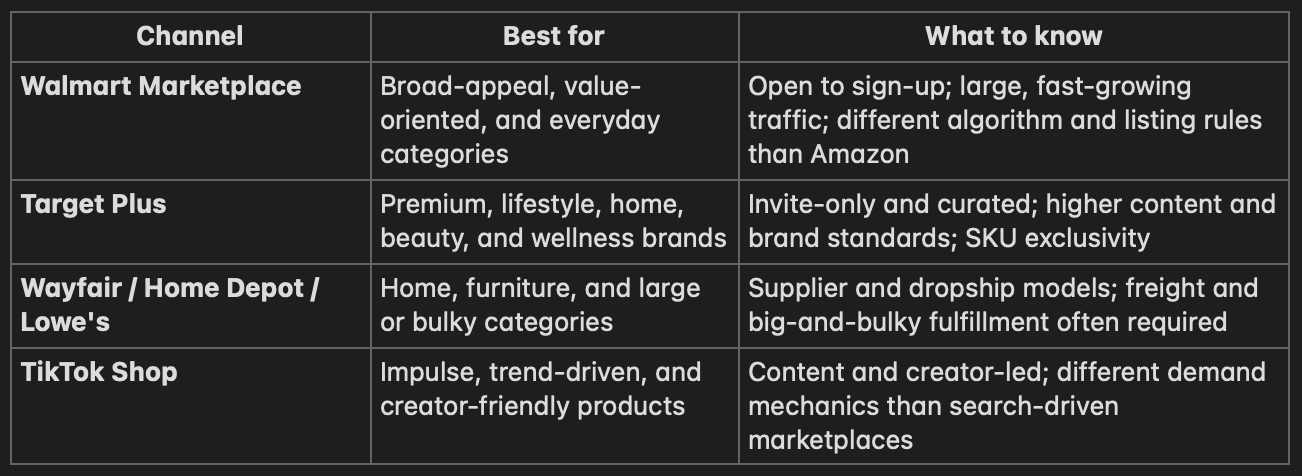
Two channels are worth calling out. Walmart is often the natural first step off Amazon because it is open and high-traffic; Walmart Marketplace growth rewards listings built for its own algorithm rather than ported Amazon copy. Target Plus is a strong second move for premium and home brands, but it is invite-only and curated; our guide to selling on Target Plus covers how to qualify and get approved. Target has committed to $5 billion in marketplace GMV by 2030, according to Target's March 2025 strategic plan, a signal of how seriously the retailer is investing in its marketplace.
How to Sell on Wayfair, Target, and Home Depot
Retail marketplaces like Wayfair, Home Depot, and Lowe's are a different animal from open marketplaces, and they are where many home and big-and-bulky brands find their best growth. They typically run on supplier or dropship models, apply their own onboarding and pricing structures, and often require freight or large-item fulfillment that standard parcel operations cannot handle.
Because these channels favor home, furniture, and oversized categories, fulfillment capability frequently decides whether a brand can even participate. For the mechanics of one of the most important home channels, see our guide to how to sell on Wayfair. The common thread across all three is that success depends less on marketing cleverness and more on operational fit: can you meet the fulfillment, freight, and service requirements each retailer sets.
How Marketplace Expansion Services Reduce the Risk
The reason expansion fails is rarely a strategy on paper; it is execution across several different operating systems at once. Expansion services reduce that risk in a few concrete ways:
- Channel-specific launches, not ported listings. Each marketplace gets listings, content, and pricing built for its own algorithm and buyer, instead of Amazon copy that underperforms elsewhere.
- One operation across many channels. Fulfillment, inventory, and reporting are managed centrally, so adding a channel does not mean adding a separate team and toolset for each one.
- Sequencing and readiness guidance. A partner helps you decide which channel to add next and when, protecting your primary channel from being starved of attention or inventory.
- Fulfillment that fits the channel. Retail and home marketplaces often require freight or big-and-bulky delivery, which a capable partner already operates rather than scrambling to build.
- Brand and pricing consistency. Expansion multiplies the places your brand and pricing can drift; managed expansion keeps both consistent across channels.
Done well, expansion diversifies revenue and reduces dependence on any single platform. Walmart's own results show why the opportunity is real: the company reported ecommerce sales up 26%, led in part by marketplace, in its fiscal Q1 2027 earnings filed with the SEC. Marketplace is a fast-growing revenue line, not a side channel.
Scaling beyond Amazon is one of the most reliable ways to diversify revenue and reduce platform risk, but only when it is sequenced well and executed channel by channel. The brands that struggle are the ones that expand too early or treat every marketplace like Amazon. The brands that succeed treat each channel as its own launch, with listings, fulfillment, and pricing built for that platform's rules.
If you are planning your next channel, start by pressure-testing your readiness: is your primary channel stable, is your capital and fulfillment ready for more, and where does your category already have demand. From there, map the sequence rather than launching everywhere at once. To see how a managed approach to marketplace expansion could run your new channels as one operation, or to explore what scaling across marketplaces looks like end to end, talk to our team.
Frequently Asked Questions
What are marketplace expansion services?
They are services that help a brand launch and grow on new sales channels beyond its main marketplace, covering channel strategy, listing setup, fulfillment, advertising, and ongoing management for each platform.
When should a brand expand beyond Amazon?
When its primary channel is stable and profitable, it has inventory and capital to stock another channel without starving the first, and its fulfillment can absorb additional order volume and service requirements.
Which marketplace should I expand to first?
It depends on your category. Walmart is often the natural first step because it is open and high-traffic, while Target Plus suits premium and home brands but is invite-only. Home and bulky brands often do well on Wayfair, Home Depot, and Lowe's.
How do I sell on Wayfair, Target, or Home Depot?
These retail marketplaces use supplier or dropship models with their own onboarding, pricing, and fulfillment requirements. Home and oversized categories often need freight or big-and-bulky fulfillment to participate.
Do I need a marketplace expansion partner, or can I do it in-house?
You can expand in-house if you have the capital, fulfillment capacity, and platform expertise per channel. A partner supplies that expertise and a single cross-channel operation, which reduces the risk of spreading your team too thin.